


OBAN Isawa GLD Driver Shaft Review

OBAN ISAWA GLD Golf Driver Shaft Review

By Russ Ryden, Fit2Score, A Dallas Fort Worth Club Fitter & Club Maker
The Highlands Performance Golf Center, Carrollton Texas 
and Daniel Spurling, PGA, Director of Player Development
Lonnie Poole Golf Course
Golf Digest Certified America’s 100 Best Club Fitters

My first impression of the new Isawa GLD is stunning. I have grown fond of Oban golf shafts for that very reason. You can spot them from a mile away. Their bright colors and well-placed shaft bands turn heads on the range and the course. I’ve always told my customers that if what they’re looking down at doesn’t inspire confidence, then they shouldn’t put it in their golf bag.  Oban certainly helps players there. The Isawa GLD is a time-tested design.  Soft mid and firm tip shafts are a great option for many players. If you’re ready to invest some money into your equipment and don’t have access to a professional Club Fitter this type of shaft would be a safe bet.

Most shafts will have different launch characteristics as they span through their weights and flexes. The GLD consistently produced similar flight through the 7 offerings. When paired with their appropriate players the shafts remained stable through on and off-center strikes and transmitted sufficient feel back up through the handle. It was notable that less skilled players, were able to more accurately identify where the strike was located on the club face while testing the GLD. They commented that they hadn’t had the ability to identify that in their previous clubs.  The torque numbers are exceptionally low for the price point Oban is offering its players. In the most laymen of terms the torque value is going to correlate with how bad your off-center strikes are going to be. When you see low shaft weight and low torque you can expect to pay big bucks. The Isawa starts with a softer butt section reenforced with a new proprietary carbon fiber material integration. There is a slight increase in stiffness in the upper mid-section around the 30in mark with the same bump in stiffness a little lower down the shaft in the extra stiff 60g and 70g shafts. I’m wondering if this is a nod to the very successful original Isawa from Oban released in 2015.

A fitted golf shaft is a platform for consistency. The fitter’s responsibility is to find the correct composition of golf club in order for the player to hit the center of the club face as consistently as their skill level will allow. I found, like the profile suggests, the GLD fits a wide variety of players. Where I see the GLD separate itself from similar shafts in its category is the butt section. When you have a stronger tip section you have to give up some rigidity somewhere else in order to translate feel back to the hands. In most cases it’s the butt section of the shaft that gets thinned out. Fitting players into the correct butt stiffness is the hardest part of club fitting because butt stiffness correlates with feel. Feel is the one thing you can’t teach. It’s organic and must be self-discovered. If you give a discerning player a shaft with too strong a butt section, they are going to tell you it feels boardy. The GLD is equipped with a softer butt section than a lot of shafts that are stronger on the bottom end. This is where it found a place in my fitting matrix. Oban has integrated a proprietary carbon fiber material to reenforce the weaker butt section of the GLD giving it exceptional energy transfer back to the players hands. I have the most success fitting the Isawa GLD with players who have back swings short of parallel. A short backswing usually denotes a quick transition and faster tempo. These swing characteristics put more stress on a shaft. When you add speed to that mix you automatically start to consider stronger shafts. I wouldn’t describe the GLD as a strong golf shaft but it certainly feels softer than it plays. The weaker butt section of the GLD provides exceptional feel to players while allowing them to venture into a stronger tip than they are used to.  I recommend the GLD to players who have faster than average tempos who are looking for enhanced feel from a stronger mid launch mid spin shaft.
Daniel Spurling

To continue reading this section of the review, you must be registered at a higher level membership.
Russ


Mitsubishi KuroKage XM Driver Shaft Review

Mitsubishi KuroKage XM Driver

By Russ Ryden, Fit2Score, A Dallas Fort Worth Club Fitter & Club Maker
The Golf Center at the Highlands, Carrollton Texas

KKXM_Image
Some shafts are simply too good to change. The Mitsubishi KuroKage Proto TiNi is one such shaft. The new KuroKage XM is the KuroKage Proto with new graphics and a wider range of weights. It is promoted as a mid launch – mid spin shaft. I view launch and spin as a propensity not an absolute. Your angle of attack, the club head loft,  where you strike and how the shaft, interacting with your loading and release, deliver the head are all part of the launch and spin equation. The XM, in the right hands, is not what I would define as mid launch / mid spin. But, shaft companies have to fill in those words for the golfing public.

The Mitsubishi website has always presented shaft EI graphics alongside their verbal descriptions. If you spend years looking at those charts and testing them on a wide range of golfers they being to have meaning. I view the difference between the KuroKage XM and the KuroKage XT as more feel related than launch. The XT has a stiffness bump low mid. That bump does contribute to a lower launch, but more important, gives a better sense of tip stability to a hard swinging late release golfer.

The technical discussion, measurements and testing results are available only to registered readers

To continue reading this section of the review, you must be registered at a higher level membership.
Russ

Project X HZDRUS Yellow Golf Shaft Review

Project X HZRDUS Yellow Driver Shaft

By Russ Ryden, Fit2Score, A Dallas Fort Worth Club Fitter & Club Maker
The Golf Center at the Highlands, Carrollton Texas

HZDRUS Yellow Image
The Project X HZRDUS Yellow is the third driver shaft in the Hand Crafted family from True Temper. It has a notably soft midsection. This is much like the first in the series, the Project X Loading Zone reviewed earlier. The bend profile is much like the profiles of the 70 gram versions of the Project X Loading Zone model. The soft zones of those shafts moved with weight and flex. I have fit a number of players into the 50 and 60 gram versions of the Loading Zone. Therefore, another shaft with that design grabbed my attention.

I had a chance just recently to test it during a fitting with a single digit handicap player that showed up with a 6 year old driver and a 103 mph golf swing. Working with the Yellow HZRDUS and a TaylorMade M1 we added 2 mph to his swing speed, 3 mph to his ball speed, dropped his spin 800 rpm all of which added 17 yards to his drives. His playing buddies are in for a surprise.

To continue reading this section of the review, you must be registered at a higher level membership.
Russ

Project X HZRDUS Black Driver Shaft Review

Project X HZRDUS Black Driver Shaft

By Russ Ryden, Fit2Score, A Dallas Fort Worth Club Fitter & Club Maker
The Golf Center at the Highlands, Carrollton Texas

HZDRUS Black Image

The Project X brand is a flagship in the golf shaft business. The brand started as an unstepped steel shaft and has morphed into carbon fiber driver and hybrid shafts. This shaft, like the Project X loading zone that came before it is hand made in the US under tight quality control processes.

The product information from True Temper tells us the shaft has a firmer midsection than the Loading Zone model. And indeed it does, lets look at the numbers:

To continue reading this section of the review, you must be registered at a higher level membership.
Russ
Aldila 2KVX NV Golf Shaft Review

Aldila 2KVX NV Driver Shaft

By Russ Ryden, Fit2Score, A Dallas Fort Worth Club Fitter & Club Maker
The Golf Center at the Highlands, Carrollton Texas

2016NV2KXVImage

A new generation of carbon fibers, that boost the strength of the material used in the construction of golf shafts are boosting strength while reducing the weight. Applying these new material to classic designs is changing the game. Advances in head design are helping us hit the ball further, advances in shaft design are keeping those longer balls in the fairway. The Aldila 2KVX NV is the third iteration of a classic design. Who can forget the original lime green Aldila NV. Of course, it was introduce such a long time ago many younger golfers have never seen it. I looked in the 2016 GolfWorks catalog and it is still there. The official second generation design, the RIP NV was reviewed here, a few years ago. When you have a design that works, and new materials, the old designs get updated.

Aldila was one of the first shaft companies to use thinner layers of material in shaft design. It was called MLT, Micro Laminate Technology, and I believe the original NV was the first shaft to use it. We are now in an time when a lot of new high density, high strength materials are being used in golf shafts. The new fibers are thinner with the same strength. The prepreg, the sheets a shaft is made from, have more fiber and less resin. This denser material is redefining how a golf shaft can be made. A new dimension of what started as MLT is evolving. What we are seeing is torque numbers going slightly higher to restore a conventional feel to high density shafts. As you compare the torque numbers of the 2KVX NV to older designs and see larger torque numbers, do not be alarmed. It is happening everywhere high density materials are used.

The technical discussion, measurements and testing results are available only to registered readers

- - -

KBS Tour FLT Iron Shafts Review

KBS Tour FLT Iron Shafts

By Russ Ryden, Fit2Score, A Dallas Fort Worth Club Fitter & Club Maker
The Golf Center at the Highlands, Carrollton Texas

FLTHeroLeftKim Braly has been designing and making shafts for around 40 years. That’s a long time. In my opinion fitting is an experience based art form and is likely to remain so. That said, over 40 years one accumulates an impressive amount of experience.

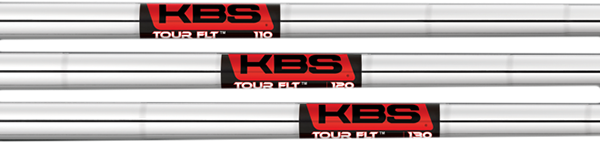
The KBS Tour was the first shaft produced by Femco steel as the KBS brand. We have seen a lot of designs since its introduction, most of which are reviewed here. This year, KBS is introducing its first flighted design. My experience with ‘flighted’ shafts goes back to the Project X Flighted designs. That design was promoted as having the propensity to create the same ball flight height throughout the set. The short irons height apex being lower and the long iron height apex being higher than the conventional set of Project X shafts.

It was not until I measured the KBS Tour FLT shafts and compared them to the KBS Tour that I understood exactly how that is accomplished. In a shaft product line like KBS, the shaft bend profiles are the same for all shafts in the design family. As they get heavier, they get stiffer. And, as they get stiffer for any particular golfer, the launch angle tends to come down. This is what I love about the KBS mix of shafts. They are available in 5 gram increments, with flex designations of R, R+, S, S+ and X. If I want to change a clients launch angle I move the stiffness up or down 5 grams. Now before the professional fitters reading this jump on me, that can also be accomplished by hard stepping or soft stepping the set. Leaving the weight the same but altering the tip lengths.

The technical discussion, measurements and testing results are available only to registered readers

In this video Kim and I discuss set stiffness gradients. After a discussion of the KBS Tour 560 and 580 shafts we talk about the FLT design. He tells us this shaft is already getting tour play. When you push the flight apex of those longer irons out, not only is there likely to be some distance gain, but the ball will have a steeper angle of descent. What I refer to as drop and stop trajectory.

Lets take a look at the numbers in a way I have not presented the here before. This style of information is now incorporated into the latest version of the Fit2Score shaft knowledge base. The set charts shown above are also from that software. 

The technical discussion, measurements and testing results are available only to registered readers

The tip to butt rations indicate a mid launch as is typical on the KBS Tour. Torque is typical for steel, low. Balance is conventional, the weight range works for the average to tour level player. The low ninety driver swing speed player is going to fit into the 110 or 115 gram R or R+ models.

To continue reading this section of the review, you must be registered at a higher level membership.
Russ