


When I entered the golf club fitting business about 15 years ago, there was not a standard rating system for golf shaft stiffness. Nor was there a way to compare golf shafts. This journal gives you a way to compare golf shafts with a uniform stiffness rating evaluation. Understanding the properties of a golf shaft which is your best fit leads to a better game.

Describing golf shaft properties is not a simple task. Shaft company marketing developed terms, “kick point”, “stiffness”, “launch” and “spin” to describe shaft properties. These terms developed into a mythological language for describing golf shafts. Shaft engineers and designers define golf shaft stiffness as a profile, the change of stiffness down the length of the shaft. Many years ago a tour of a shaft company R&D lab enlightened my understanding of golf shaft technology.

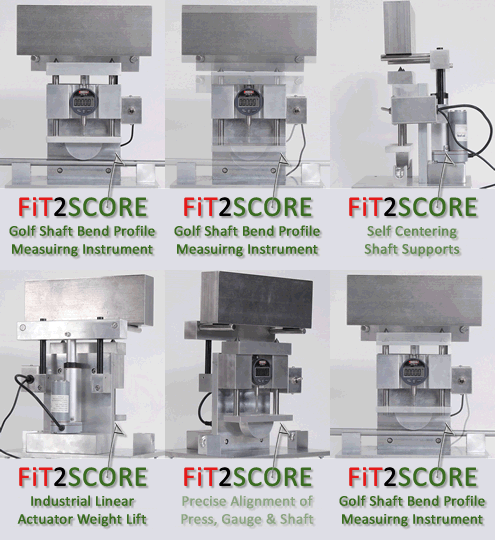
That lead to me designing and manufacturing a very accurate shaft stiffness measuring instrument. It is now used by several shaft companies. I have been writing about shaft properties for 10+ years. The term EI profile, is now part of the discussion some shaft companies are having with golfers.

If you want to understand golf shafts you have come to the right place. Here you can learn why some shafts work better for you than others. And more important, how to recognize the properties of shafts that make you a better golfer. Please share your comments about what you experience with the shafts reviewed.

A system which defines the distribution of flex down a golf shaft is how most shaft companies design golf shafts. But the information, for fear of giving that information to their competitors, is not shared with the public. It took a few years to refine my measurement instrument and many, many years to acquire and measure the popular golf shafts. This journal provides you with uniform measurements of thousands of golf shafts. If you are new here, the TECHNOLOGY MENU is a collection of articles that will guide your understand golf shaft design.

This journal is entirely supported by subscription. To insure my integrity, there are no ads on this site, that allows me to remain unbiased in the articles. If you believe as I do, that your golf shafts are essential to good golf, please subscribe. Acquiring shafts, measuring them and writing articles takes a great amount of time. Your subscription underwrites the time and resources needed to keep this journal going and growing.

This video is a detailed discussion about golf shafts stiffness and the history of how they were measured and marketed. It is one of many videos about golf equipment technology and golf club building on my youtube channel, Devoted Golfer.

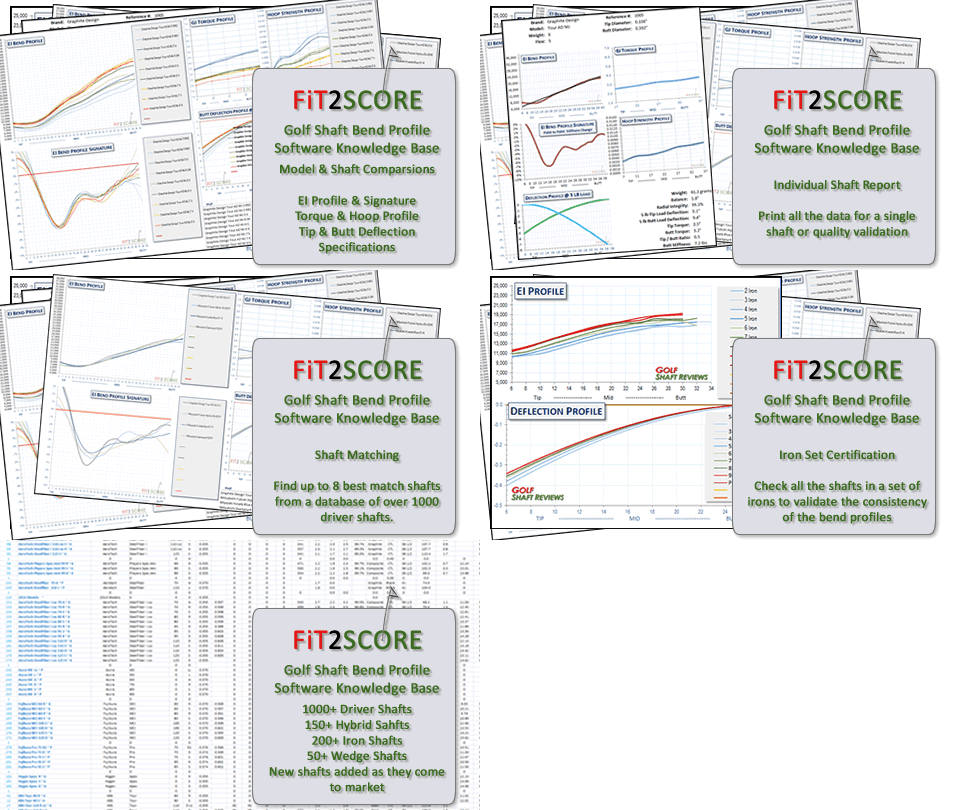
It took years to understand shaft measurement and many more years to accumulate a meaningful database of shaft measurements. The magnitude of that accomplishment did not occur to me until a golf shaft company owner said it to me. Several golf shaft companies now use the EI measuring instrument I designed and manufactured. If you are a golf professional and would like access to more data there are two choices. Golf Professional subscribers get access to a larger set of data and individual profiles of all the shaft model weights and stiffness variations that were made available. Fit2Score Affiliates have access to the entire database through Excel. To hear a podcast interview I did about golf shafts with Tony Wright, a Fit2Score Software Affiliate, Click Here.

Follow DevotedGolfer on Facebook to be advised of new posts.

Ping Ascending Weight (AWT) 3.0 Iron Shaft Review

By Russ Ryden, Fit2Score, A Dallas Fort Worth Club Fitter & Builder


The Highlands Performance Golf Center, Carrollton Texas 
Golf Digest Certified America’s 100 Best Club Fitter

PING first introduced the original AWT (Ascending Weight Technology) steel shafts in 2007, rolling them out as the stock steel shaft option for the PING G10 and i10 iron series. The original AWT shafts were co-developed with Nippon marking a shift for PING in shaft suppliers.The AWT design philosophy utilizes ascending weight, meaning the shafts get progressively lighter in the long irons (to increase clubhead speed and launch height) and heavier in the short irons (to maximize control and accuracy). PING has iterated on this technology over several generations. The third generation AWT 3.0 was introduced in 2025 for the G440 irons.

Distribution of the Ping AWT, made by Nippon, is available only in Ping irons. My set of review shafts came for pullout sold on EBay. I have only measured the S flex model but knowing the quality of Nippon products, the profile is very likely to represent other stiffnesses.

To continue reading this section of the review, you must be registered at a higher level membership.
Russ

True Temper 2026 AMT Iron Shafts

By Russ Ryden, Fit2Score, A Dallas Fort Worth Club Fitter & Builder

The Highlands Performance Golf Center, Carrollton Texas 
Golf Digest Certified America’s 100 Best Club Fitter

The idea behind Ascending Mass or Ascending Weight shafts maximize distance and launch in long irons and enhance control and feel in short irons. They do this by making each shaft heavier from long irons to short irons. This matches the typical progression of iron head weighs. The lighter long irons may increase your club head speed generating higher spin, launch and distance. The short irons with heavier, firmer shafts provides a solid feel at impact promoting tighter dispersion.

True Temper was the pioneer in creating the original concept of mass-market ascending weight steel shafts, while PING was the first to successfully popularize and mainstream the technology under a designated retail iron lineup. While the concept of matching golf clubs date back decades, the mechanical engineering required to commercially produce a single steel shaft set with built-in progressive weights went through a distinct chronological evolution between the two brands.

The 1990s: True Temper Tri-Gold (The Historical First)True Temper technically beat PING to the concept by roughly a decade. In the late 1990s, True Temper introduced a niche, ahead-of-its-time shaft model called the Tri-Gold. It divided a standard iron set into three distinct weight and flex zones: the long irons were lighter to promote launch, the mid-irons were a standard weight, and the short irons were heavier for control. While it laid the early engineering blueprint for ascending mass, the Tri-Gold was somewhat clunky compared to modern smooth progressions and failed to capture major commercial adoption.

To continue reading this section of the review, you must be registered at a higher level membership.
Russ

Project X Red Iron Shaft Review

By Russ Ryden, Fit2Score, A Dallas Fort Worth Club Fitter & Builder

The Highlands Performance Golf Center, Carrollton Texas 
Golf Digest Certified America’s 100 Best Club Fitter

It has been some time since I reviewed the Project X Blue Iron Shaft. The Project X Red iron shaft released in Mid 2025. Thee have been a number of Project X irons shaft models over the past several years. Many of which have been discontinued.

To continue reading this section of the review, you must be registered at a higher level membership.
Russ

Mitsubishi 2Gen Tensei 1K Pro Orange Driver Shaft

By Russ Ryden, Fit2Score, A Dallas Fort Worth Club Fitter & Builder
The Highlands Performance Golf Center, Carrollton Texas 
Golf Digest Certified America’s 100 Best Club Fitter


A second generation of the Mitsubishi Tensei 1K Orange has released. The notation on the tip is RIP. I recall a line of Aldila shafts before Mitsubishi acquired Aldila labeled RIP. I had to do some research to restore my memory of the technology. This is from an former Aldila shaft designer, “RIP is an acronym for Reverse Interlaminar Placement.  Normally, in shaft design, the bias ply layers (+/- 45 deg fiber angle) are on the very inner diameter of the shaft.  With RIP some of the bias ply is moved to the outside of the shaft.  Mechanically, the farther the material is from the centerline the more efficient it is.  Since bias plies are used to control torque, moving some of these plies outboard gives better torque control. 
Lets look at how the second generation Tensei Orange compares to the first generation.

To continue reading this section of the review, you must be registered at a higher level membership.
Russ

Mitsubishi Vanquish Green Driver Shaft Review

By Russ Ryden & Shawn Plepel
Fit2Score, A Dallas Fort Worth Club Fitter & Builder
The Highlands Performance Golf Center, Carrollton Texas 
Golf Digest Certified America’s 100 Best Club Fitter

There is a lot of confusion around what actually is “quality” and “high tolerance” in golf shafts. Mitsubishi’s Vanquish VV (green) threads the needle on this issue, here is why…

There are several methods to form carbon fiber golf shafts, let’s use these main 3 as example: table rolling, filament winding, and more recently TPT’s ribbon winding technique. 

Despite their differences, what remains the same is that everyone thinks their own method produces the absolute best quality & tolerances… So how do we decipher this marketing as teachers, fitters and consumers???

To continue reading this section of the review, you must be registered at a higher level membership.
Russ