The Aldila Rogue driver shafts have now all been reissued with 130 MSI prepreg. The Aldila website informs us that Mitsubishi Chemical fiber and prepreg is used exclusively in the shaft. Mitsubishi acquired Aldila several years ago. Aldila and Mitsubishi are one of the few brands, perhaps the only brand, in the business to produce the materials their shafts are made with. Lets look at the rogue Black EI profile and then compare it to the Rogue White and Silver.
To continue reading this section of the review, you must be registered at a higher level membership. Russ
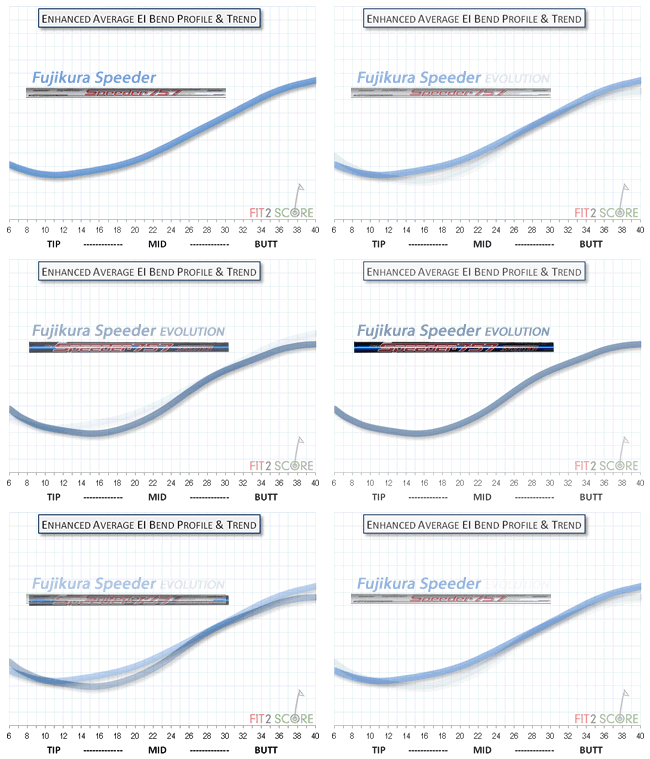
The Fujikura Speeder 757 was my introduction to premium driver shafts many years ago. The Speeder brand name disappeared for many years. It was brought back a few years ago as the Motore Speeder, a complex matrix of 26 shafts, featuring 3 launch designs, each in an array of weight and flex. In late 2013 the Speeder brand was reintroduced with 8 shafts, numbered like the original Speeder. The Fujikura Speeder Evolution came to the golfing public in 2015. It is designed to handle the heavier driver heads we are now seeing. As you can see in this illustration, the tip is stiffer and there is a tip-mid stiffness adjustment as part of the design update.
Like all of the Speeder models from Fujikura the profiles are consistent throughout the model. As the weight increases so does the stiffness. The Speeder 474 R2 weighs 48 grams uncut. The weights and stiffness ascend from a 4″ deflection yielding 5.8 lbs for the 474R2, and 8.6 lbs for the 79 gram 757X. The raw shafts are 47″ long, not the typical 46″.
Lets take a look at the profiles, they vary by model:
The technical discussion and measurements are available only to registered readers
The Speeder Evolution is a classical design, mid soft in relation to a stiffer butt and tip.This design is a good fit for the majority of golfers. We can see the research done on the 3D ENSO system shaping the butt to create softer handles.
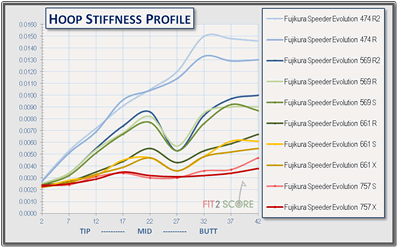
An interesting aspect of these shafts stood out during hoop stiffness testing. A significant ‘bump’ of hoop stiffness in the high midsection of the shaft. If you look at the EI curves you will see this is where the shaft is quickly descending in stiffness. At that point, an ultra high modulus hoop ply was added to preserve shaft stability.
Hoop stiffness is a function of wall thickness. near the tip, where the wall of the shaft are thick, the hoop stiffness is high. This graphic shows hoop deflection measurements. The less deflection, the stiffer that area of the shaft is. This is hoop stiffness, not bend stiffness. Hoop stiffness relates to the shaft ovalizing. The lower the number, the less oval deformation I measured. So, the dips you see are increases in hoop stiffness. The design objective in the Fujikura Speeder Evolution is to create shaft stability, and hence feel, in the section of the shaft where to majority of the load related bending occurs. What you see is the result of engineered wall thickness and high density pitch fiber pregreg in the hoop orientation, stabilizing the mid/butt region of the shaft.
An interesting discussion on another golf forum contained this comment, “This is the answer to all the “profile is profile” theorists – whose claim is that if I match bend pattern, weight, balance point and frequency then my $12 shaft is the same as your $175 shaft. Torque progression and distribution aren’t as handy to quantify but are essential elements in any high-performance design, and aren’t to be had for peanuts.” We see in the Speeder Evolution design is what this writer was talking about. A highly evolved design using the latest high density fibers, fiber orientation and wall thickness control to create a performance enhancing golf shaft.
Many of you have probably seen a KBS Tour 105 shaft in stock TaylorMade RSi 1 and RSi2 irons. As of the date this review was published this shaft is not available in the USA after market, the review samples were shipped from the KBS factory in Taiwan.
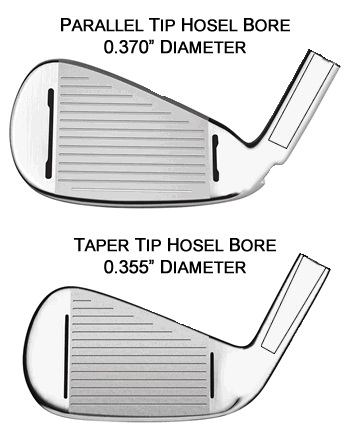
The KBS Tour 105 used in the TaylorMade RSi’s are parallel shafts. A taper version will soon be available to club makers in the USA. For those that are not club makers and are not familiar with the terms parallel and taper let me explain. This illustrations shows the bore in the hosel of a club head. Some heads, like the RSi1 and RSi2 have parallel bores. The hole in which the shaft is inserted has parallel sides. They are typically 0.370″ diameter. They are designed for parallel tip shafts. Heads designed for constant weight taper tip shafts have a tapered bore. The bottom of the hole is 0.355″ diameter and slowly increases in diameter.
Taper tip shafts are sold in sets. Each shaft in the set is specifically designed for a particular iron, 3i, 4i, 5i, etc. The shaft lengths in the set are in 1/2″ increments and typically weigh the same despite being different lengths. The stiffness of the shafts is set by the designer. The shafts are butt trimmed by the club maker to get to the lengths needed for you set. Parallel shafts are sold individually, one length for the entire set. They are tip trimmed by the club maker to create stiffness for the different irons then butt trimmed to create the lengths needed for the set. Because they are trimmed from both ends, the shaft weight gets lighter as it gets shorter.
The balance of sets made with constant weight tapers and parallels is different. You should not attach a value judgement to that fact. But you should realize that if you are accustomed to the balance of one design, changing designs will affect your game despite the fact that the swing weights will be the same. If you want to learn more about this it is explained in greater depth in the technical article, Parallel and Constant Weight Iron Shafts.
Now that you have a basic understanding of Parallel shafts, lets take a look at the KBS Tour 105 parallels.
The technical discussion, measurements and testing results are available only to registered readers
The after market addition to the KBS Tour line of shafts, the 105 constant weight tapers is coming soon. Stay tuned, 105 grams is a great weight and will be a great compliment to the CTaper light in a fitting system matrix of shafts.
The Graphite Design Tour AD Hybrid is the second hybrid shaft released in 2015. It follows the YS Reloaded, the YS has long been one of my favorites. The Tour AD HY is the fourth version of the Tour AD hybrids, but it is the first I have reviewed. Like most, my primary focus is driver shafts, then iron shafts. The hybrid in recent years is seen as an extension of the iron set. The early hybrids, were too long and did not gap properly into most golfers bags. Over the last few years the trend has moved toward shorter shafts lengths and a view toward integrating the gapping of the set from the longest irons you can hit well into hybrids. Most sets I build recently contain 2 or more hybrid style heads, both traditional hybrids as well as driving irons.
When do you take that step, breaking away from your iron set and blending in a hot faced driving iron or launch enhancing hybrid head? Its a simple answer actually. When you see your gaps collapse its time to get the next longest club built in a way to maintain consistent gapping between clubs. And there are many ways to do that which extend beyond the scope of this reviews. One aspect of getting more club head speed and higher launch is changing to a lighter, higher launching shaft. This is where we enter to world of hybrid shafts.
Higher launch is easy, make the tip softer. All to often, especially in stock shafts, this comes with higher tip torque. I have been playing exotic carbon fiber, low tip torque shafts for a very, very long time. The problem in this realm is the gag reflex I get from most golfers when they learn that a great hybrid shaft can be more than what they typically see hybrid clubs sold for. The Graphite Design Tour AD HY is one of those exotics, retailing at $175 uninstalled. Is it worth it? Time after time, when I finish the fitting objective I am working on with a client I hand them my hybrid and ask them to try it. And time after time, the reaction is the same, the OMG moment. Then sticker shock.
A properly fit, high quality hybrid shaft is a long term investment. You might change heads as head technology evolves, but that properly fit hybrid shaft stays with you and moves into the next head. In my bag, that pair of hybrid shafts have been with me for going on 8 years.
What is special about a great hybrid shaft? Three aspects, high launch propensity, tip stability and weight. I will discuss each of these as it relates to the Graphite Design Tour AD HY measurements shown here.
The technical discussion and measurements are available only to registered readers
This discussion about Graphite Design Tour AD shafts occurred at the PGA Merchandise show, January, 2015. To see more video like this visit the DevotedGolfer Youtube Channel.
- Charts & Comments for Golf Professional Subscribers -
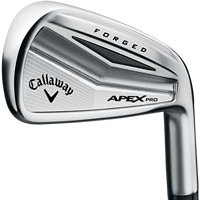
When we get back to back wins 2013 in the Scottish Open and the British open the shaft in the bag of the Phil Mickelson gets a lot of attention. Well, it turns out it was it a tour prototype that is now available. It is an unusual profile for steel but not unique. Here is a look at the KBS Tour V which now is the stock steel shaft in the 2014 Callaway Apex Pro Irons. It has a long handle, every so gently declining in stiffness until the about 14″ from the tip. Then it declines rapidly. I have heard Kim Braly refer to the design as ‘fast tip.’
It is noteworthy to mention that the stock graphite in the 2014 Callaway Apex Pro is the UST Recoil. An interesting choice of premium shafts, in a classy players design iron head.
The technical discussion, measurements and testing results are available only to registered readers
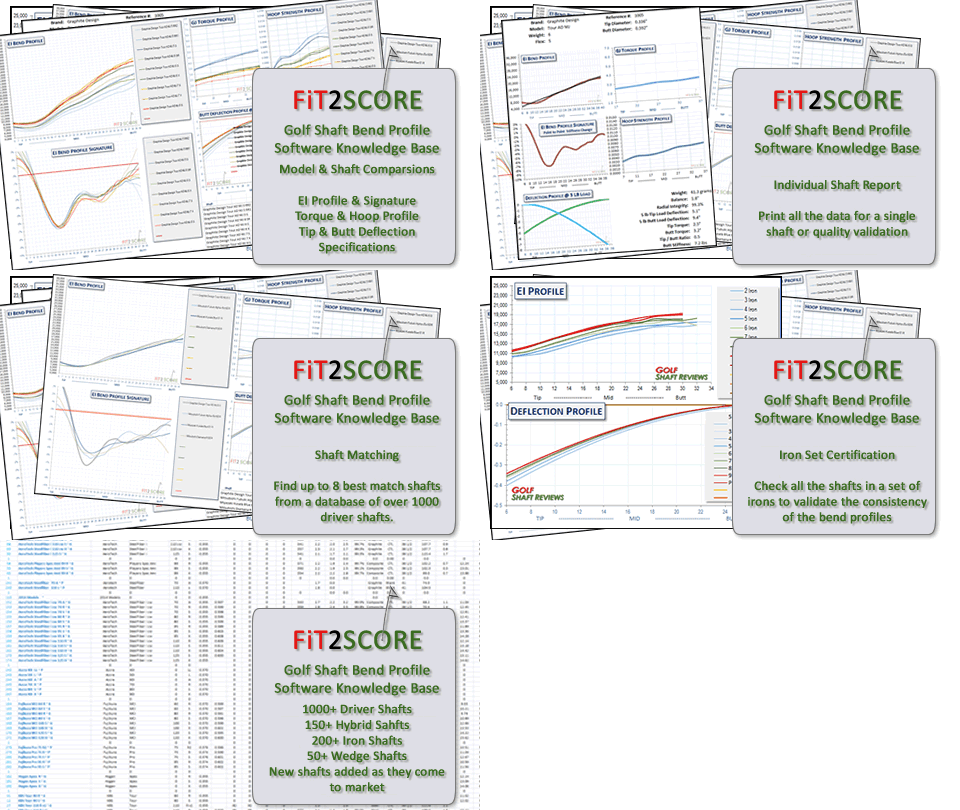
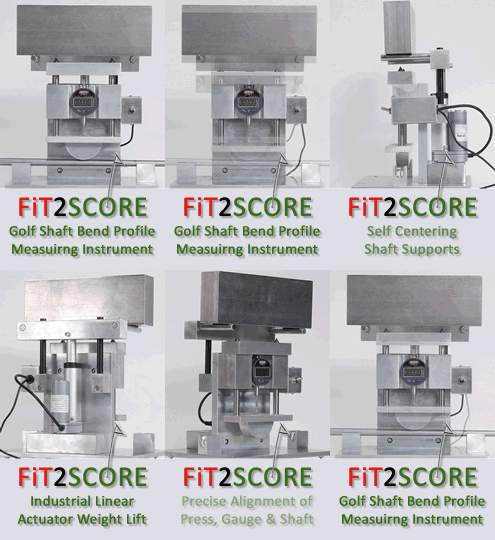
Within the golf club fitting and building community there are now three methods to understand bend profiles of shafts. A future technical article will discuss the history and methods of the systems. The 3 point bend system used in these reviews is classical textbook engineering for beam measurement. It is the language spoken by the vast majority of golf shaft designers and engineers. That is why I built the Fit2Score software around this measurement methodology.
I tested a review sample installed in a Miura CB-501 on the range and was surprised at how tight my ball flight dispersion was. I had expected more variation from the soft tip. That was not the case, the balls were flying true despite a heavy cross wind the day I was testing. As with any golf shaft, you will not know if it is right for your swing without testing it.
To continue reading this section of the review, you must be registered at a higher level membership. Russ
Graphite golf shafts are reported to have been first introduced to golf in 1973. In the early days of graphite golf shafts some of the expertise in the graphite business was in the fishing rod business. And a few of those companies entered the golf business. One of those was G. Loomis, still a prominent brand of fishing rods.
Jeffery Meyer began designing graphite shafts with Aldila in 1987. He went to work for Gary Loomis as Director of Engineering in 1992 and the Loomis shafts he designed quickly developed a following on the PGA Tour. The company was sold to Aldila in 1996 and Jeffery went to work for Acushnet as Director of Golf Shaft Development and was later given the responsibility of developing Titleist’s metal woods. The Loomis brand is now back in the hands of Meyer Performance Composites. Loomis shafts are back, and the brand has Jeffery and Robert Meyer at the helm. Robert, is a professional player and a former tour rep. This video is my first meeting with Jeff Meyer at the 2015 PGA Merchandise Show in Orlando. The actual discussion went long beyond 30 minutes so I cut some of is out. I knew I had met a like minded individual as the discussion got very technical.
I did measurements of both the EFP 95 and the EFP Tour models. The shafts are made for Loomis by Mitsubishi. That got my attention. What really got my attention was the use of the Mitsubishi TiNi wire in the tip of the shafts. It was introduced many years ago in the light weight Bassara Griffin. It is now used in the KuroKage Silver and KuroKage Tour driver shafts. It is a highly elastic thread woven into the tip of the shaft. In designs with similar profiles, the TiNi wrapped versions have less loss of stiffness in the tip area resulting in lower launch and spin. This is the first I have seen it used in an iron shaft.
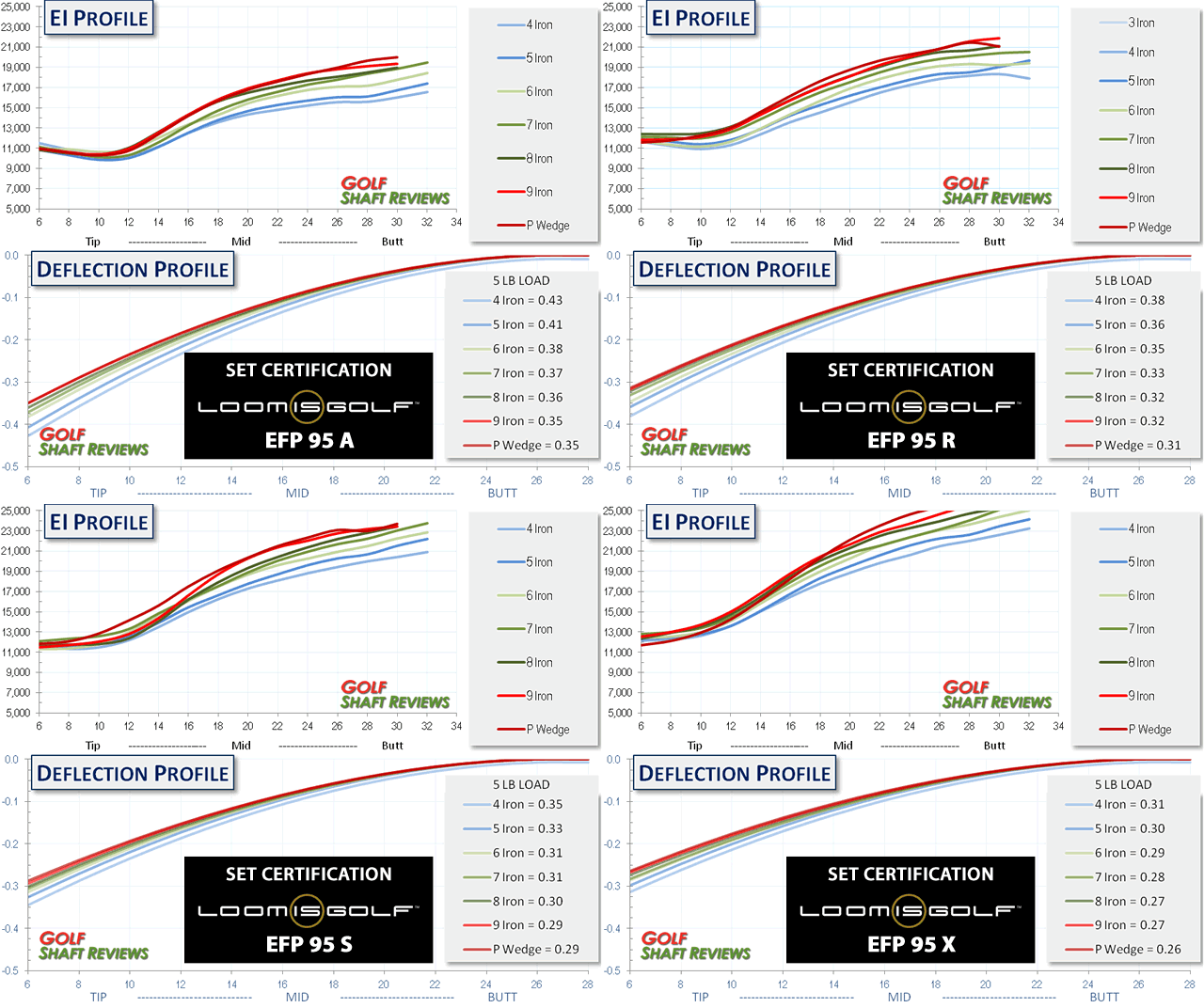
I created a process using my EI instrument that I call set certification. Every shaft in an iron set gets measured down its length in 2″ increments. The process identifies outliers, shafts that do not match the bend profiles of the rest of the set. Recent testing on graphite constant length taper sets have not been encouraging. What I have been seeing had me ready to go back to using parallel graphite shafts in iron sets. And if you knew me well you would understand just how much I abhor that idea. Knowing the Loomis shafts are made by Mitsibushi, and knowing how consistent the no longer available Fubuki AXi shaft was, I asked Jeff Meyer to send me one set of each of the EFP95’s to check. The following graphic are the set certification profiles. I LIKE what I see. If you are looking for premium graphite 95 gram iron shafts put the LOOMIS brand on your radar. These are consistent sets. I have measured many, many set of these and they are simply the most consistent sets of graphite constant weight taper shafts currently in the market.
The graphics on the shaft are big and bold. If you do not like them in your face, you can simply install them label down. The back side in a pleasant solid silver completely neutral to the eye. I like it. There is no concern with orientation of these shafts, the radial consistency was 99.5% with a standard deviation of 0.1%. Summary, it does not get any better than that, these shafts are round.
My experience measuring countless sets of iron shafts has lead me to understand that you cannot compare iron shafts by simply looking at the 6 irons as many have traditionally done. Yes, the view of a single shaft in the set is a useful way to compare shafts, but irons sets are made with 8 different shafts. And they do not necessarily have the same bend properties throughout the set. “Flighted” was the descriptive term coined years ago with the Rifle brand. True Temper now coined a new word I like, “progressive launch”. And I am now revisiting the popular iron shafts in my database and adding measurements of the longest and shortest irons in the sets. As luck would have it, the Loomis 95 and the Tour models represent the two ends of this issue and illustrate why this is important.
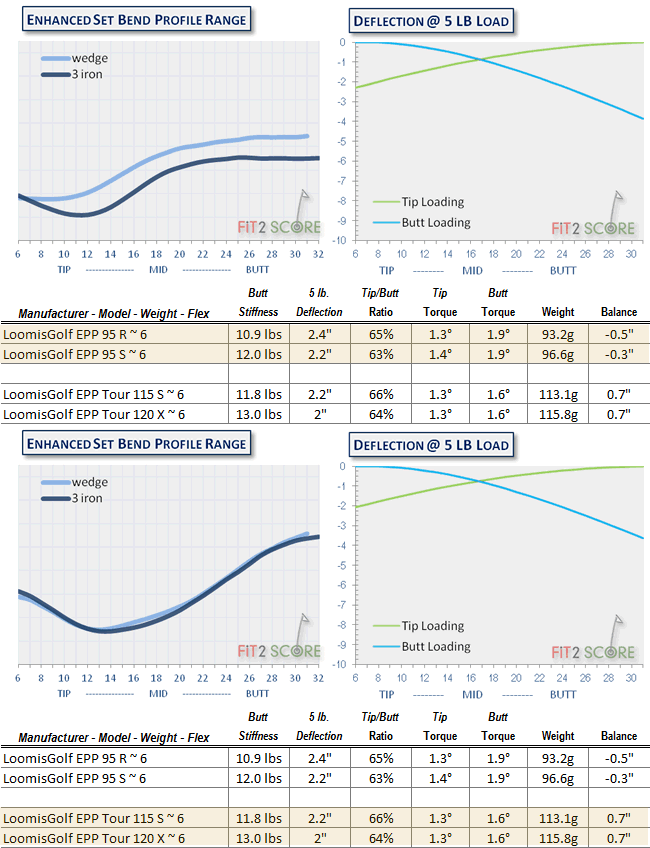
The Loomis EFP 95 is a mildly progressive launch design. The wedge profile is ‘straighter’ than the 3 iron shaft. I discuss this at length in the article on Parallel Shafts. Not extremely so as some sets are, but you will get a higher launch in your long irons from the Loomis EFP 95. The mid 90 gram iron shaft is a weight range I find is a great fit for the average golfer. I am told the 125 version now in production will be much the same. The torque of both models is steel like. The 95’s are slightly low balance, the Tour’s slightly high balance.
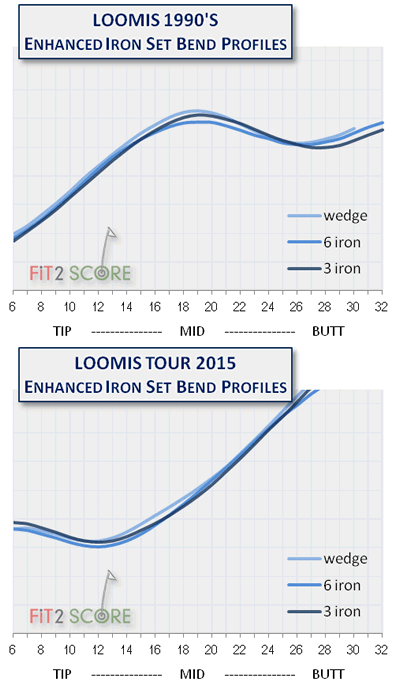
That brings us to the Tour model. It is a radical design. All of the shafts in this set have identical bend profiles. They are discrete lengths, manufactured in discrete lengths. The weight descends in the set, with the weight ranging from 109 g wedge shaft to 118 g 3 iron shaft. Jeff Meyer had a set of the 90’s Loomis iron shafts sent to him and forwarded them to Golf Shaft Reviews for a comparison. The identical bend profile design is indeed the same as the the Loomis shaft of the 90’s. The bend profiles however are quite different. The 2015 Loomis Tour profiles is similar to what we currently see in composite irons shafts. The 1990’s design bears a resemblance to the KBS Tour V’s and the Nippon Modus3 130’s.
The idea is to create a set with a narrower butt frequency range that what is typical. I checked these with typical 3i, 6i and Pw heads at standard lengths and they do in fact exhibit that property. The butt frequency range is about half of what one would typically see. If you understand that stiffness and launch are interrelated, stiffer launching lower than softer on a good ball strike, you would then predict that the short end of the set in such a set would launch higher than a traditional build. And I am told that is indeed true.
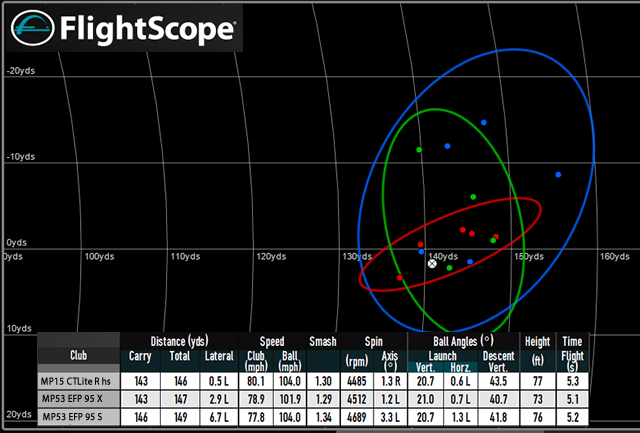
I took the 6i EFP 95 S & X flex I now have in my fitting system to the range. Fitted with an Mizuno MP53 head, the launch and spin were identical to my gamer, a Mizuno MP15, fitted with a hard stepped R Flex 105 gram C Taper Lite. The 10 gram weight difference showed up in dispersion.
When you are properly fit and groove your swing timing to a particular weight and balance, as I have, hitting another club is a good reminder of how important club fitting is. Websites that feature articles of club comparisons always amuse me for just that reason. Club comparisons show how well a particular club fits you, and have little to do with much else. Differences in average numbers are also meaningless unless the standard deviations are provided. In research, three standard deviations are the acceptable standard for demonstrating a significant difference.
With my 78-80 mph 6i swing, the S flex felt a little soft and the X a little crisp. That is a big issue to consider in finding your perfect fit. There is a fine line between the sweet feel of a shaft that is slightly softer than you should be playing and one the will produce tight dispersion patterns. When I went to the X, the feel was crisp, but the dispersion was tighter. Yes a few shots were longer with the R, but if your aiming at pins, and swinging inside your range of motion, those occasional long shots mean long downhill putts, or even worse, chips from the back of the green. I would soft step the X were I to put this shaft in my bag.
If a 95 gram shaft is your fit, and you like the feel of composite shafts, you should be testing the Loomis EFP 95. You will not find a more consistent set of shafts.



 By Russ Ryden, Fit2Score, A Dallas Fort Worth Club Fitter & Club Maker