Project X IO Golf Shaft Review

Project X IO Golf Iron Shaft Review

By Russ Ryden, Fit2Score, A Dallas Fort Worth Club Fitter & Club Maker
The Highlands Performance Golf Center, Carrollton Texas 
Golf Digest Certified America’s 100 Best Club Fitter

The Project X IO was released in 2020 with the Project X LS and shares the new True Temper look of a matte brushed chrome finish. It is in the same weight range as the discontinued Project X PXi but has a different EI profile. It is lighter and has a low tip to butt stiffness ratio to promote a higher launch.

To continue reading this section of the review, you must be registered at a higher level membership.
Russ

Golf Shaft Hoop Strength

Golf Shaft Hoop Strength

By Russ Ryden, A Golf Digest America’s 100 Best Clubfitter
Fit2Score, Dallas Fort Worth, Texas
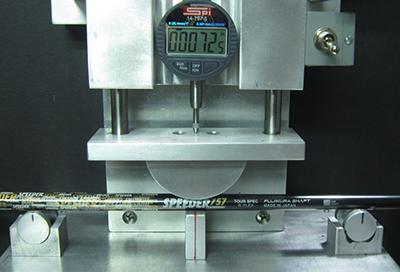
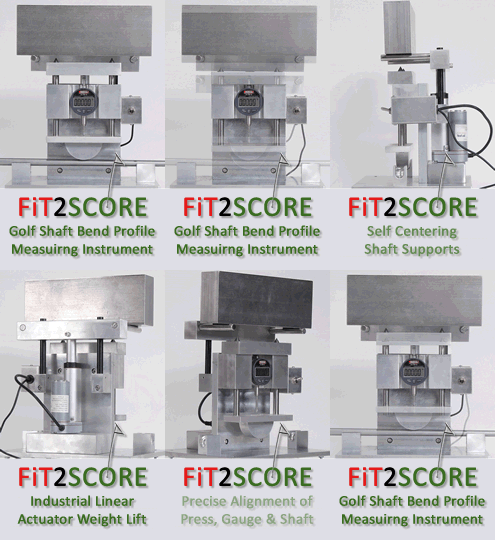
Hoop_MeasuringHoop strength is discussed endlessly in the marketing of golf shafts but unlike other specifications, we are given no information about actual strength of one shaft vs another. After trying a few methods to measure hoop strength I arrived at the method shown to the right. It is a text book method, place a tube on a firm surface, drop a weight on it and see how much is deforms. I built a small block, slightly higher than the guides used for EI measuring and now have a tool for quantifying hoop strength. If this is a new term for you, follow this link to the AeroTech web site for a discussion. For those readers familiar with the term, you should note that the shaft in this image has some of the highest hoop strength I have yet to measure. It is a pull out that I played many, many years ago before I developed the current passion for understanding the golf shaft. A material called triax was wrapped into the shaft to add hoop strength and eliminate ovaling during the golf swing.

My first attempts to measure hoop strength were to look for ovaling. I clamped a shaft on a deflection device, measured the diameter at different points, bent it 5″ and measured again at those points. The differences were so small I decided there was more noise in the numbers I was reading than the variance I was trying to measure. I could not find .001 inch of difference. That might just make the rest of this article a waste of time, but if you are interested in the concept read on. With the device pictured above, the shaft is compressed with 11 kg and a change in diameter is apparent. The scale on the graphics is .002 inch increments.
Hoop_GraphiteCarbon Fiber Iron Shafts

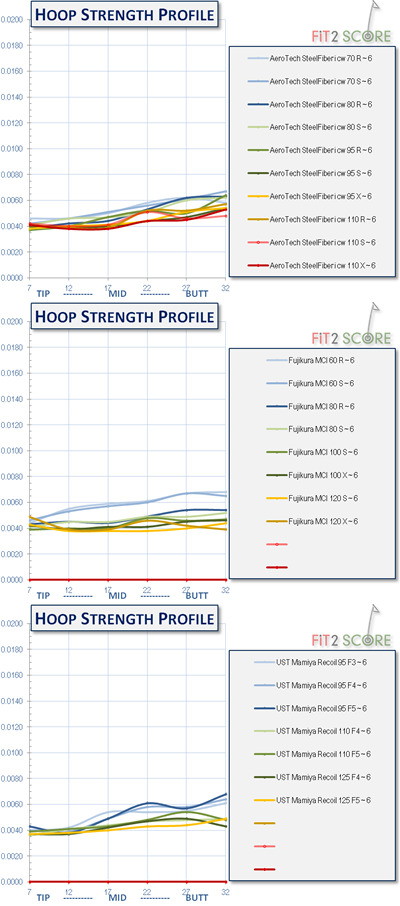
The focus of this article is iron shafts. I have not yet measured the shafts in my driver fitting system. Lets start by looking at my hoop strength measurements of some popular graphite six iron shafts that I fit with. Graphite wall thickness in heavy iron shafts creates high hoop strength. AeroTech maintains high hoop strength even as the shafts become lighter as a result of the filament winding process they uniquely use and the stainless steel wire wrapped around the shafts.

What you see looking at these charts is that heavy graphite shafts universally have high hoop strength. And even light weight graphite, the 70 gram AeroTech and the 60 gram Fujikura MCI, which also employs a metallic fiber in the shaft walls have high hoop strength.

As you look at these charts, take note that a low number, meaning very small deflection under load, indicates high hoop strength.
Hoop_SteelsSteel Iron Shafts

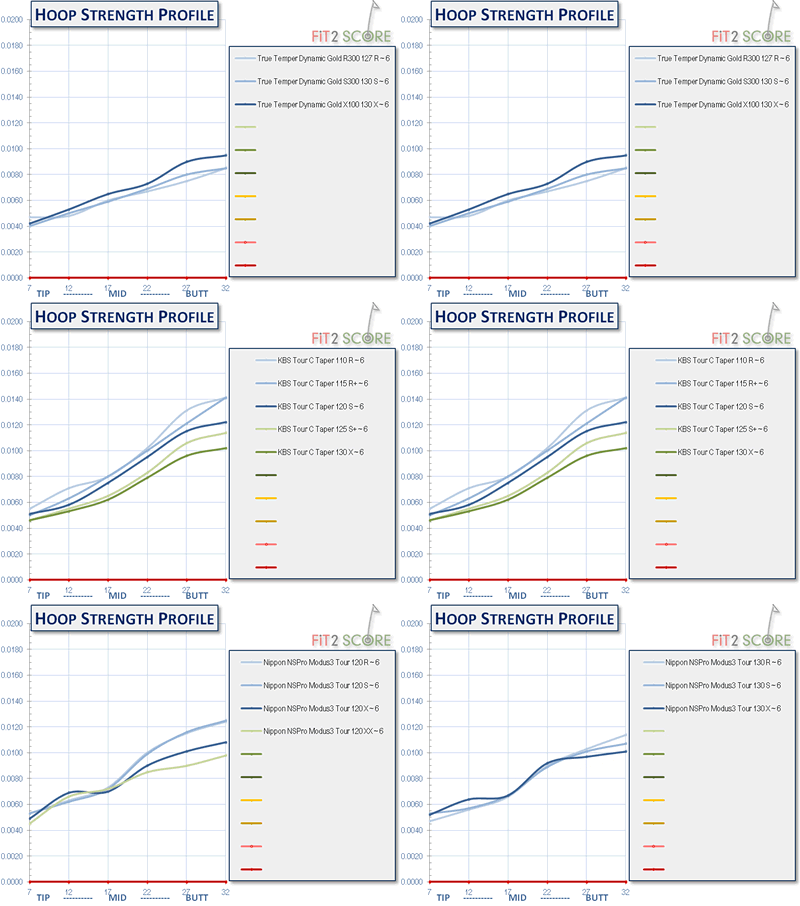
Now lets compare the hoop strength of some popular steel iron shafts. We immediately see less hoop strength in the butt sections of steel shafts. This is not limited to a particular brand, it is universally true.

What I found really interesting was that the hoop strength profiles were the same shape as the EI profiles. The stiffness of a steel shaft is determined by the wall thickness and the diameter of the shaft.

The material, a steel alloy, is consistent through out the shaft. In contrast, carbon fiber composite shafts material properties can change through out the shaft.

But wait a minute. I looked at both the Modus3 Tour 120 and the Modus3 Tour 130. Both have very different EI profiles. Yet, the hoop strength profiles are similar. Nippon steel has some interesting technology in their production lines.


Hoop_ZelosLight Weight Steel

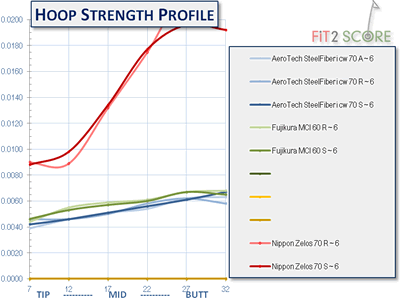
One final image, a comparison of Ultra Light Steel to high quality light weight carbon fiber iron shafts. Do not come away with the impression that all light weight graphite shafts are going to have hoop strength like the high end shafts you see here. They do not.


What does it all mean to your game. I cannot say with certainty at this point how hoop strength manifests itself in shaft stability and dispersion control. Or if it can create kick velocity. Nor can I give you direction on what amount of hoop strength is appropriate for your loading patterns. You are looking at these charts within a week of creation of this addition to my knowledge base. But, at least now we have a measurement platform to begin the discovery process.

Mitsubishi KuroKage Tour Edition TINI Driver Shaft Review

Mitsubishi KuroKage Proto TINI Driver

By Russ Ryden, A Golf Digest America’s 100 Best Clubfitter
Fit2Score, Dallas Fort Worth, Texas

MRC_KuroKage_Tour

The KuroKage Proto TiNi is available only through selected Mitsubishi dealers. I briefly covered this shaft in an earlier review and did not give it the attention it deserves. It is currently in the driver of the #1 player on the PGA tour. His shaft is a custom made version, beyond the 7-XX available to Mistubishi dealers. My friend Biv Wadden has me continuously building drivers for his students with this shaft. When you have as many shafts as I do in my fitting system, some go unnoticed as I tend to fit what I know. Biv’s praise of this shaft got me to take a closer look and start testing the shaft myself.

“For the past year, I’ve been putting most of my competitive students into the KuroKage prototype tour edition shaft with its nickel-titanium tip – in both drivers and 3-woods. It consistently produces higher ball speeds and lower dispersion than any other premium shaft I use.”
Biv Wadden

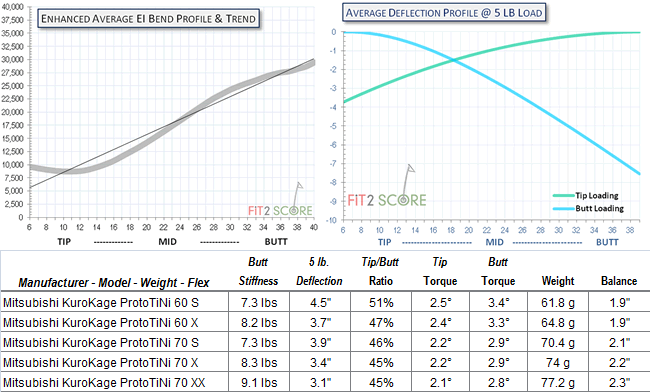
The result, the Diamana ilima’s, which have had a 3 year run in my fairways have been replaced with KuroKage Proto’s. With a $400 price tag this is not likely to become a best seller. Unless of course you try it and it fits your swing. Here is a look at the shaft measurements from the latest version of the Fit2Score knowledge-base.

MRC__KuroKageProto_EiTBTbRadial integrity of the samples was 99.5% with a 0.3% standard deviation, excellent. Hoop strength was a little lower on the handle end of the 60 gram shafts. The balance is high like most driver shafts now being produced. The profile shows a soft handle, moderate mid, stiff tip design, with a maximum bend in the 14″ region. The lower 12″ of the shaft is wrapped with Titanium Nickel Wire touted by Mitsubishi as able to stretch then immediately regain its original shape. This material is used in the KuroKage Silver, but the Proto has a longer section of the impregnated with the TiNi wire. While both shafts incorporate the TiNi wire, the profiles are about as different as MRC profiles get.

The KuroKage Proto was the first of the heavier shafts to incorporate the TiNi wire that had been used in UltraLight Bassara series of shafts. It was also the first to use 40 ton fiber. Mitsubishi Rayon is now using 80 ton fiber in the hoop layers of the third generation Diamana’s. The Bassara UltraLite Phoenix, released in 2014 is a light weight version of this profile. It adds the lighter weights not offered in the KuroKage Tour Edition shaft.

The profile is very similar to the Diamana ilima. The butt a little stiffer the tip a little softer. It launched much the same for my swing with a little less spin, creating a more boring flight. The 70-XX in the hands of the +110 kids is delivering tight dispersion, with good trajectory and a little lower spin than would be expected for the launch. And that combination, as Biv tells me, equates to distance.


Ping CFS Iron Shaft Review

PING CFS Iron Shafts

PingCFS_S_Image

By Russ Ryden, A Golf Digest America’s 100 Best Clubfitter
Fit2Score, Dallas Fort Worth, Texas

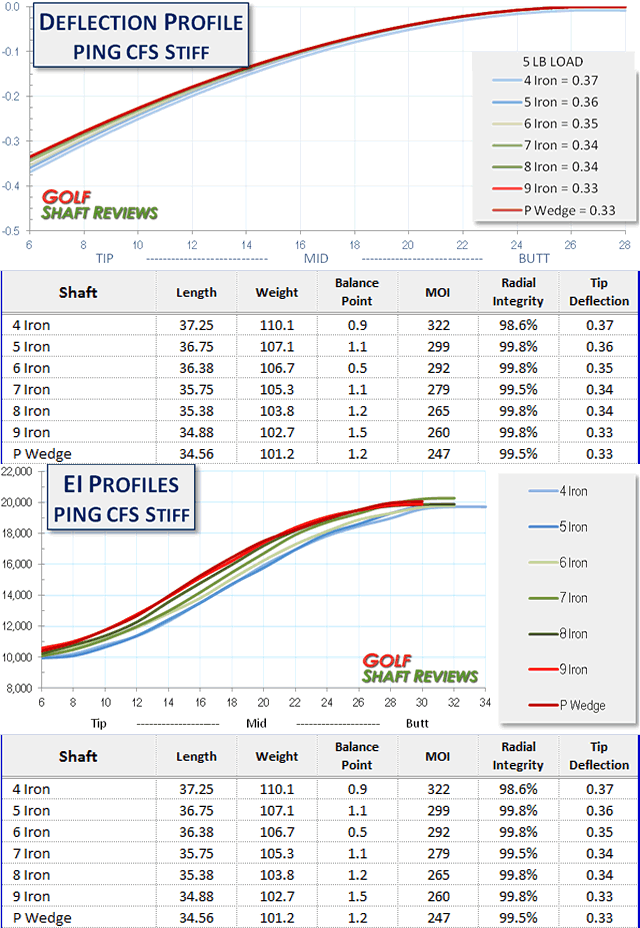
As a club fitter it is important to know what your are fitting with and the makeup of my customers existing clubs clubs. I did a reshaft of a set of Ping irons recently and had a chance to profile the pull outs. Here is what I measured:

To continue reading this section of the review, you must be registered at a higher level membership.
Russ


PingCFS_S_EIDfTbFor comparison with other shafts on this site, the 6 iron butt stiffness was 12.9 lbs. Tip to butt ratio was 56%, indicating a mid launch. This is a parallel shaft with a .370 tip. That can be seen in the descending weight as the shafts get shorter. To some degree, the tip stiffness compresses through out the set. This can be seen by looking at the range of mid shaft stiffness compared to tip and butt stiffness range. This is typical in sets made from the same shaft that have the tip section shortened to create additional stiffness as the club heads in the heads get heavier.

What I have seen in measuring other sets of Ping irons was that they achieved both swing weight matches and were very close to MOI matches. I regret not having measured this set before I pulled it apart. The descending weight caused a fairly substantial change in the shafts contribution to the total MOI of the club. Perhaps this is why I have seen swing weight and MOI matched sets of Ping irons.[\resrict]

True Temper XP115 Golf Shaft Review

True Temper XP 115 Iron Shaft

TT_XP115_image

By Russ Ryden, A Golf Digest America’s 100 Best Clubfitter
Fit2Score, Dallas Fort Worth, Texas

A heavier model of the True Temper XP iron shafts was released in 2014. It joins the 95 and 105 gram versions reviewed earlier. I have been told an 85 gram version has been released in Asia and will likely become available in the US in 2015.

I have added new charts and expanded the measurements I am taking on shafts. The new Fit2Score instrument includes an appliance for measuring hoop strength. This is explained in an article in the technology section. The EI bend profiles show the shaft bend profile as a series of measurements of 10 inch sections of the shaft, in 1 inch increments. While this shows us a detailed view of the shaft and allows for comparison with other shafts it does not show how the shaft behaves when loaded. The deflection chart shown below uses the EI measurements with a load applied to the tip and butt of the shaft, illustrating how the shaft bends when loaded. This is a classical method for measuring shafts. It was done on a deflection board. With EI measurements we can do it with math and chart the results.

To continue reading this section of the review, you must be registered at a higher level membership.
Russ

The True Temper XP line of shafts solves a problem I have had with True Temper iron shafts. There simply were too many models for me to understand. Now, with a 95, 105 and 115 version of the same design we have a uniform set of weight and stiffness fitting options in the weight range that fits most golfers. If we look at a subset of this, the 95R, 105R, 105S, 115R and 115S we have a fitting matrix with nearly identical bend profiles. And that is a great mix of mid weight fitting options for a product that is available in many fitting carts.

ACCRA Concept CS1 Golf Driver Shaft Review

ACCRA Concept CS1 Driver Shaft

By Russ Ryden, A Golf Digest America’s 100 Best Clubfitter
Fit2Score, Dallas Fort Worth, Texas

ACCRAconceptCS!_ImagePremium Golf Management evolved from a Canadian distributor of golf shafts to a producer of the ACCRA brand of golf shafts. They have long term business relationships with most of the professional golf club fitter / builders in the world. The golf fitters that attend the annual PGA merchandise show in Florida all arrive a day early for ACCRA day. A day of golf hosted by ACCRA  gives them all a chance to renew relationships and exchange ideas.
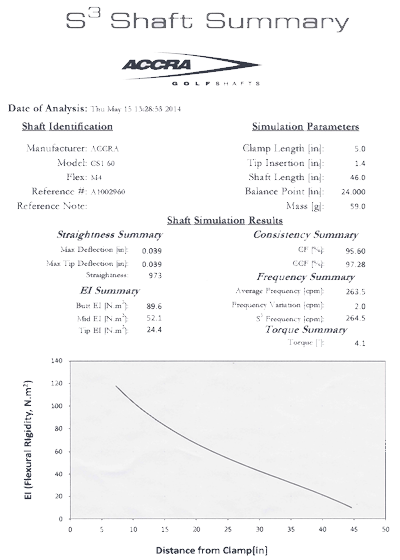
ACCRAconceptCS!_S3Summary
The 2014 Concept CS1 is another step in the evolution of ACCRA. Shown to the right is a shaft summary document that comes wrapped around every Concept golf shaft.

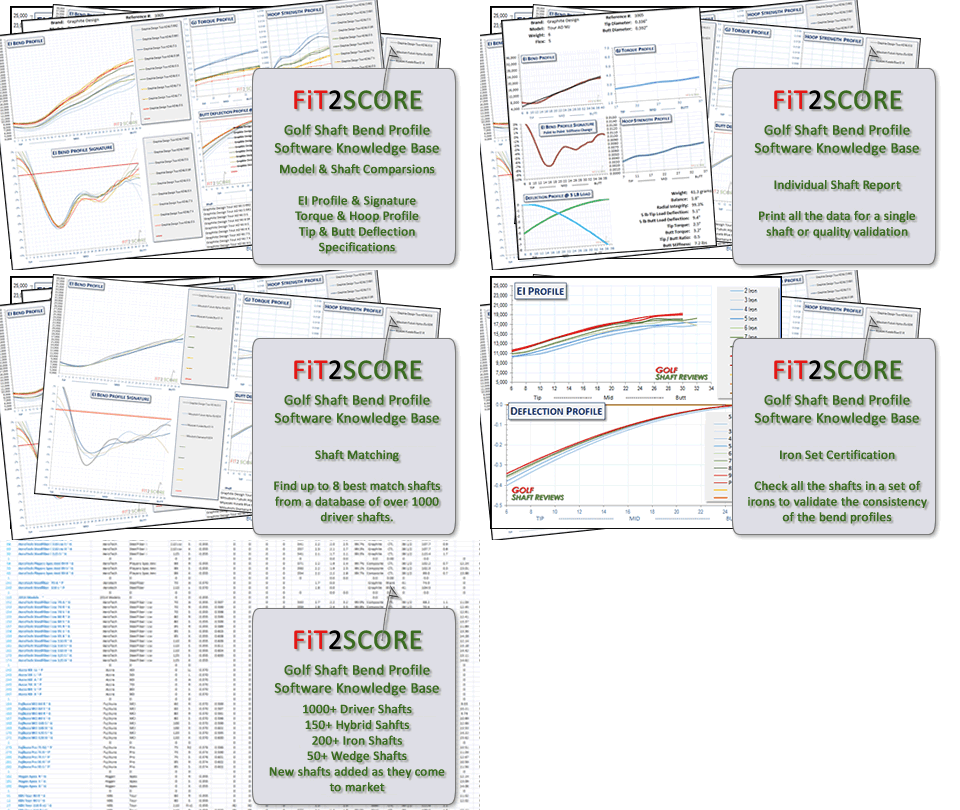
Several years ago PGMC, purchased one of the Fit2Score shaft measuring instruments. It brought manufacturing consistency into focus as it has now for the several shaft companies that own the instrument. Through a partnership with Mark Timmes a fully automatic shaft measuring instrument was invented.

To continue reading this section of the review, you must be registered at a higher level membership.
Russ


The ACCRA Concept CS1 is on the cutting edge of shaft design. Find an ACCRA fitting partner and take one for a test drive.

---