Mitsubishi Diamana B-Series Third Generation Blue Board

The third generation of the Mitubishi Blue Board, the B-Series released in late 2012. The original graphics show on the bottom is sold in Asia. A revised graphic, the top image, toning down the floral pattern is sold elsewhere. Same shaft. The Blue Diamana was to my knowledge the first of the Diamana Family of shafts. My first encounter was in a Taylor Made TP driver. It was the beginning of a long lasting relationship. The Diamana Blue profile has been one of Mitsubishi’s best sellers. It is butt stiff / mid soft / tip stiff. The profile has been copied by most brands as one of their models. The second generation Diamana Blue was the Kai’li. It was the first of the Mitsubishi Diamana shafts to use a wrapping technique called Multi Dimensional Interlay. 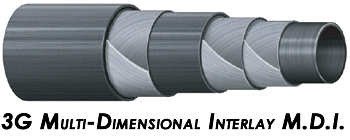 All the the second generation Diamana’s, the Kai’li, Ahina and ilima featured stiffer tip sections than the first generation designs which resulted in longer sections of uniform stiffness. The Kai’li refined the original Diamana Blue profile with a slightly stiffer butt and tip.
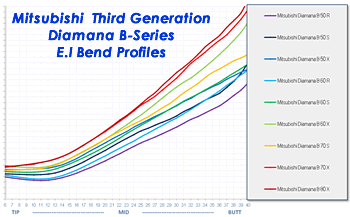 In all the Mitsubishi Shafts, weight and stiffness from shaft to shaft ascend uniformly. That means the 70 S shaft is stiffer than the 60 S as you can see in this illustration. This makes it easy for a fitter to move from weight to weight, knowing the bend profile of the shaft does not change. Not all brands follow this design choice. Some change profile with weight.
The third generation Diamana Blue takes the stiffness of the design up a notch.
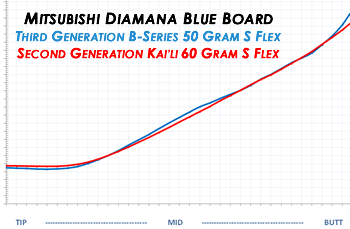 With the release of the KuroKage model in 2012, Mitsubishi introduced a high density prepreg using more fiber and less resin. The PR talked about adding strength by changing the proportion of fiber to resin. This technology is now being used in the third generation Diamana B-Series. . What I see is a 10 gram weight reduction. The 50 gram B-Series is the same as the 60 gram Kaili. Same stiffness, same bend profile, but 10 grams lighter. Look at the previous chart to understand this. Recall how the Mitsubishi shafts ascend in weight and stiffness. Now, just ratchet the profiles up a notch, lighter is now stiffer. And I am now fitting the player I would have put into the 60 gram Kai’li into the 50 gram Diamana B. The Diamana-B series in available in a wider weight range than former models. 50 gram R, S and X flex shafts are now available.
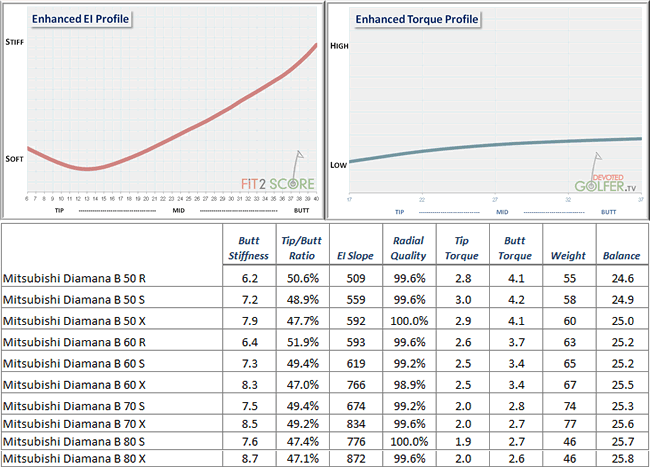
Where we do see a difference is in torque. The 50 gram shafts have 1/2 degree more torque than the 60 gram models. Still in an acceptable range, 3.0 tip, 4.2 butt in the 50 S. As shafts get lighter, they generally need more torque to transmit feel. With the mix of Kai’li and the B-Series in a fitting cart, the Mitsubishi fitter has an interesting range of options in the search for the perfect fit. The Blue Board design is the a perfect fit for the golfer with a quick tempo and aggressive transition. I view it as a neutral launch, not biased toward high or low. With the addition of a 50 gram model, the gap between the Ultra Lite driver shafts and the typical 60 gram shaft has been bridged.



 The Highlands Performance Golf Center, Carrollton Texas