Mitsubishi KuroKage Tour Edition TINI Driver Shaft Review

Mitsubishi KuroKage Proto TINI Driver

By Russ Ryden, A Golf Digest America’s 100 Best Clubfitter
Fit2Score, Dallas Fort Worth, Texas

MRC_KuroKage_Tour

The KuroKage Proto TiNi is available only through selected Mitsubishi dealers. I briefly covered this shaft in an earlier review and did not give it the attention it deserves. It is currently in the driver of the #1 player on the PGA tour. His shaft is a custom made version, beyond the 7-XX available to Mistubishi dealers. My friend Biv Wadden has me continuously building drivers for his students with this shaft. When you have as many shafts as I do in my fitting system, some go unnoticed as I tend to fit what I know. Biv’s praise of this shaft got me to take a closer look and start testing the shaft myself.

“For the past year, I’ve been putting most of my competitive students into the KuroKage prototype tour edition shaft with its nickel-titanium tip – in both drivers and 3-woods. It consistently produces higher ball speeds and lower dispersion than any other premium shaft I use.”
Biv Wadden

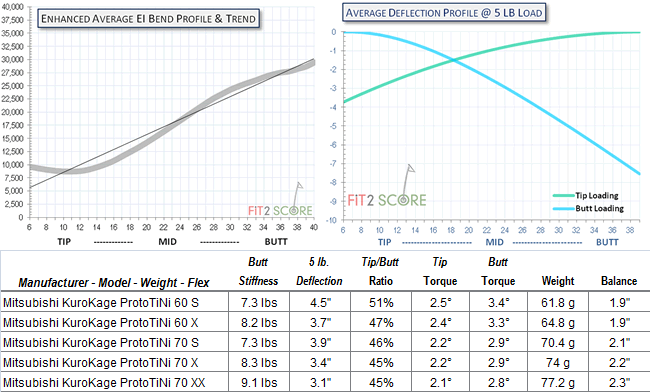
The result, the Diamana ilima’s, which have had a 3 year run in my fairways have been replaced with KuroKage Proto’s. With a $400 price tag this is not likely to become a best seller. Unless of course you try it and it fits your swing. Here is a look at the shaft measurements from the latest version of the Fit2Score knowledge-base.

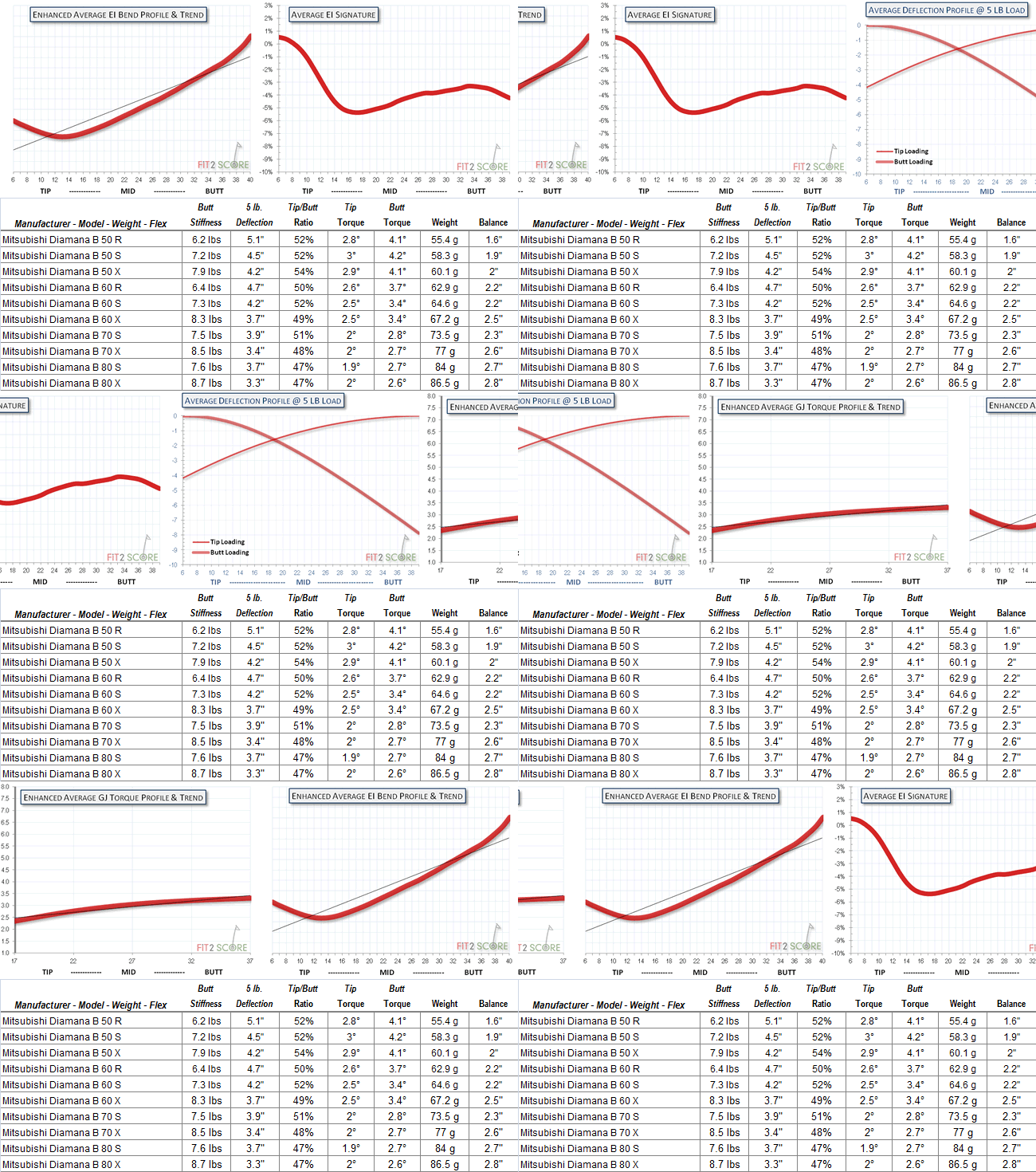
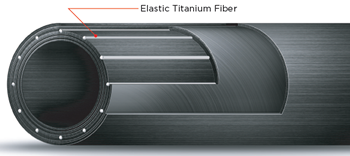
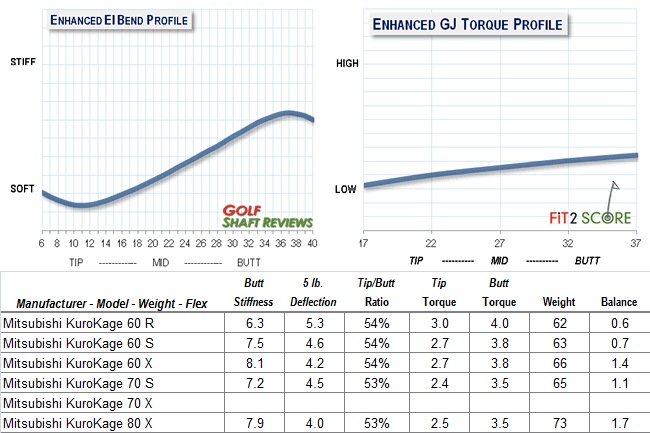
MRC__KuroKageProto_EiTBTbRadial integrity of the samples was 99.5% with a 0.3% standard deviation, excellent. Hoop strength was a little lower on the handle end of the 60 gram shafts. The balance is high like most driver shafts now being produced. The profile shows a soft handle, moderate mid, stiff tip design, with a maximum bend in the 14″ region. The lower 12″ of the shaft is wrapped with Titanium Nickel Wire touted by Mitsubishi as able to stretch then immediately regain its original shape. This material is used in the KuroKage Silver, but the Proto has a longer section of the impregnated with the TiNi wire. While both shafts incorporate the TiNi wire, the profiles are about as different as MRC profiles get.

The KuroKage Proto was the first of the heavier shafts to incorporate the TiNi wire that had been used in UltraLight Bassara series of shafts. It was also the first to use 40 ton fiber. Mitsubishi Rayon is now using 80 ton fiber in the hoop layers of the third generation Diamana’s. The Bassara UltraLite Phoenix, released in 2014 is a light weight version of this profile. It adds the lighter weights not offered in the KuroKage Tour Edition shaft.

The profile is very similar to the Diamana ilima. The butt a little stiffer the tip a little softer. It launched much the same for my swing with a little less spin, creating a more boring flight. The 70-XX in the hands of the +110 kids is delivering tight dispersion, with good trajectory and a little lower spin than would be expected for the launch. And that combination, as Biv tells me, equates to distance.


Mitsubishi Bassara Phoenix UltraLite Driver Shaft

Mitsubishi Bassara P UltraLite Driver Shaft

By Russ Ryden, Fit2Score, A Dallas Fort Worth Club Fitter & Club Maker
The Golf Center at the Highlands, Carrollton Texas

Bassara_Phoenix_Image

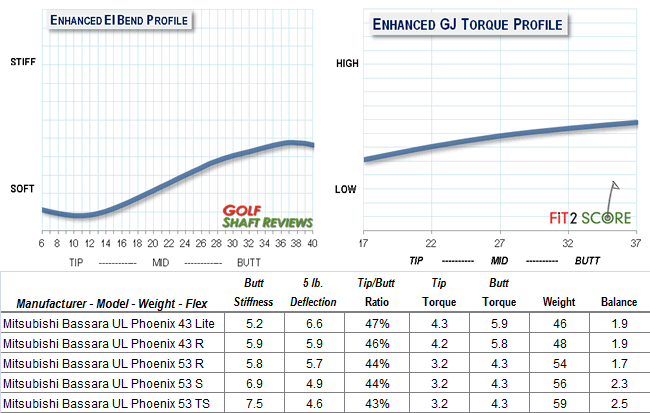
In 2013, Mitsubishi Rayon began the introduction of shafts that are available only from Authorized Mitsubishi ClubFitters. The UltraLight Bassara Phoenix released in 2014, is the third such shaft.. The color is dramatic, a burnt orange with a clear coat finish. The bend profile is a perfect match to the KuroKage Proto TINI, the first of the fitter only shafts. That profile is one of my favorites for a well trained swing. TINI stands for Titanium Nickel Wire. It was first use in the Ultralight Bassara “G” series shafts. It is now being added to many shafts. It is a high elastic material that can stretch and immediately regain its original shape. In addition to storing and releasing energy, it stabilizes the shaft tip.

TINI_illustrationTip stability results in tight dispersion. A consistent loss of stiffness makes this profile easy to load and many find it adds dramatic distance to their drives. The KuroKage Proto TINI is only available in 5 models ranging from 60S to 70XX. The Bassara Phoenix completes the range, starting with a  30 gram L flex and ascending to a 59 gram TS flex.

Bassara_Phoenix_EiGjTb

The radial consistency is excellent, averaging 99.4% with a 0.3% standard deviation. If we look for similar designs in iron shafts, the KBS Tour is the closest bend profile design. Both have a consistent loss of stiffness from butt to tip, Near the tip, the stiffness increases to stablize the head during impact. With such designs, tipping will actually remove some of the tip stiffness. With the Bassara Phoenix, if you want more stiffness, get a heavier, stiffer shaft. Tipping is not recommended for this shaft. Alignment of the Phoenix is not necessary nor will it be beneficial. The radial consistency of the Phoenix makes it excellent for rotating hosels.
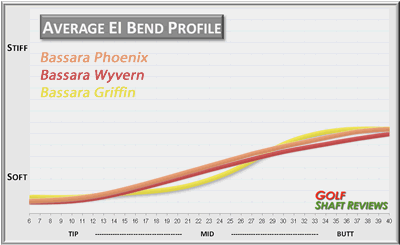
Bassaras_EiGjA comparison of the current Bassara UltraLight models shows the Phoenix and the Wyvern to be quite similar. The Phoenix profile indicates a little more launch. The Phoenix is modeled after the ilima profile. In fitting after fitting, I put more ilima’s into fairways metals than all other shafts combined. The 53TS Bassara Phoenix is a great shaft if you are looking to build an ultralight fairway.

This shaft is available at shop.golfshaft.reviews 

To continue reading this section of the review, you must be registered at a higher level membership.
Russ

Mitsubishi KuroKage Blue Driver Shaft

Mitsubishi KuroKage Driver Shaft Review

By Russ Ryden, A Golf Digest America’s 100 Best Clubfitter
Fit2Score, Dallas Fort Worth, Texas

MRC_KuroKageBlue_Image

In 2014 Mitsubishi reintroduced the Bassara V shaft as the dealer only KuroKage. It is a great looking shaft, Blue ion finished. It has a great history, this was Lorena Ochoa’s shaft. Many years ago I fit a great many of these. It is a Diamana Blue with about a half degree more torque. The radial consistency of all the samples measured was 99.6% with a 0.3% standard deviation. Translation, excellent. Install this shaft in any orientation, use it in a rotating hosel. Shaft to shaft consistency; as good as it gets, the fitter and the shaft your club gets built with will be indistinguishable from each other.

MRC_KuroKageBlue_EiGjTbIf you are familiar with the Misubishi Blue Board design, you know this shaft. In a former life it looked like this:

MRC_BassaraV_ImageSome of the shafts I measured for this review came from the fitters that were still in my shop. I was impressed that many years ago when this shaft was first available that the radial quality was exceptional.


Mitsubishi Fubuki Z and Fubuki ZT Golf Shaft Review

Mitsubishi Fubuki Zeta & Fubuki Zeta Tour Driver Golf Shafts
Callaway Big Bertha 2014 Stock Driver Shafts

By Russ Ryden, A Golf Digest America’s 100 Best Clubfitter
Fit2Score, Dallas Fort Worth, Texas

Fubuki Z

FubukiZ_Image

Several years ago Mitsubishi Rayon began making high quality shaft models for the golf club manufacturers. These designs closely resemble the Mitsubishi Rayon premium shafts. The Fubuki Zeta and Fubuki Zeta Tour continue this tradition. The driver market has settled in on a $400 price point and most premium shafts range from $300 to $850.  For some, these prices are justified by performance, for others, they are not.

drivers-2014-big-berthaThe 2014 Callaway Big Bertha stock shaft is the Fubuki Zeta or simply Fubuki Z. For those that are familiar with Mitsubishi Rayon golf shafts, the shaft design is indicated by the little letter that is left of the weight.

The technical discussion, measurements and testing results are available only to registered readers

Diamana Series W Golf Shaft Review

 Mitsubishi Diamana W-Series Third Generation White Board

By Russ Ryden, A Golf Digest America’s 100 Best Clubfitter
Fit2Score, Dallas Fort Worth, Texas

MRC DiamanaW ImageThe third generation Diamana White Board is a departure from previous designs. Like many shafts in the 2013-2014 season of super low launch head designs, it creates a higher launch tendency presentation of the head to the ball.

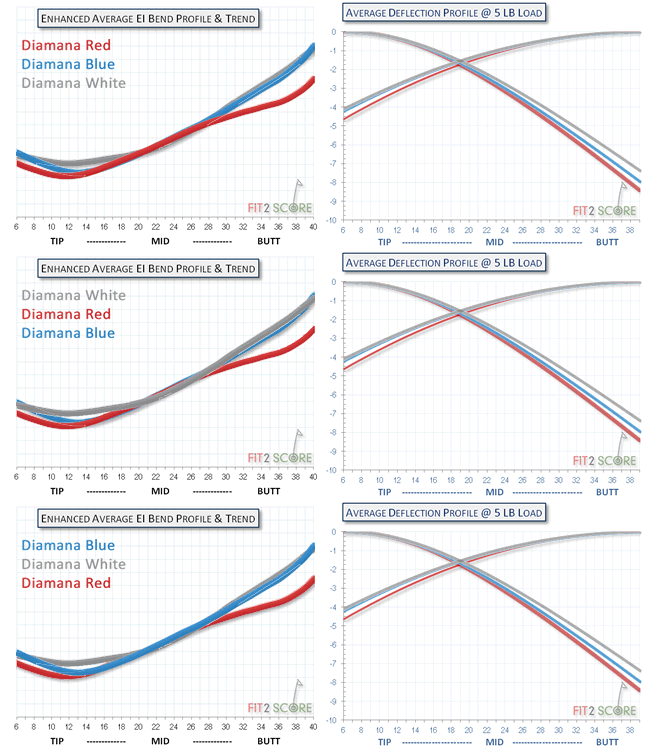
Three Generations of Diamana White Designs Compared

MRC Diamana 3Gens
There was little change between the first generation Diamana White Board and the second generation ‘ahina. Torque was unchanged, weight went down slightly as the era of higher density materials began. A stiffer tip area required an adjustment to the mid section of the shaft and a quicker loss of stiffness in the mid-tip transition zone.

In the third generation Mitsubishi Diamana W Series we see a huge change in the EI profile of the shaft. The Tip to Butt ratio, a simple indicator of launch tendency is unchanged, but the path there is quite different. The signature profile of the White Board, and its cousin, the Mitsubishi Fubuki Alpha, a mid shaft bump in stiffness is gone. What we see now is a profile that is similar to many shafts, a consistent loss of stiffness from butt to tip. The signature mid shaft bump is still there, albeit lower and softer. And, unlike previous generations, there is a slight but significant change in profile as the Diamana W series gets heavier.

UltraLight vs 50 gram models

A 50 gram version has been added to the line.  The Diamana W series 50 gram model have higher torque, consistent with creating feel in a light weight shaft. The tips are softer, and in looks much like a stouter version of the ultralight Bassara W series. The line between ultra light shafts and light weight versions of standard Mitsubishi models is blurred with the introduction of 50 gram shafts in both the Diamana W and Diamana B shafts. The Bassara models extend down to 40 gram models, but the 50 gram Diamana’s bridge the gap between the 50 gram Bassara’s and the 60 gram Diamana’s.

MRC Diamana W EiGjTb

Radial quality of all the review samples was excellent. The Diamana W series is suitable for rotating hosels without any regard for alignment. As you can see from the chart above, it does not get any better than this.