The Project X brand is a flagship in the golf shaft business. The brand started as an unstepped steel shaft and has morphed into carbon fiber driver and hybrid shafts. This shaft, like the Project X loading zone that came before it is hand made in the US under tight quality control processes.
The product information from True Temper tells us the shaft has a firmer midsection than the Loading Zone model. And indeed it does, lets look at the numbers:
To continue reading this section of the review, you must be registered at a higher level membership. Russ
The Project X LZ, or loading zone shaft features a linear soft zone in the middle of the shaft which is visibly reinforced with bias wraps to maintain torsional stability. This 2014 composite driver shaft from True Temper, released under the Project X brand, is made in limited numbers in the USA facility in San Diego California. I am told only 60 or 70 can be made in any given day with current staffing.
This is an interesting option now being offered by a few companies. The general golfing public has access to the shafts that are made in the tour department for the tour players. Most graphite shafts are hand rolled. As such, the care taken by the person putting the shaft together is reflected in the quality and consistency of the finished shaft. Almost every company has some highly skilled wrappers that make their prototypes. And very often, when these people are not making protos, they are making the shafts that go to the professional tour vans. These shafts are not necessarily better than the shafts made in the volume production shops, but they are free of the shaft to shaft inconsistencies found in the factory produced product. And I have seen some inconsistencies that are hard to believe from the high volume, low cost foundries, but that is another story.
The concept of the Load Zone was to create a soft midsection in the shaft. Mid soft shafts are among the most popular shaft in my fitting experience. No shaft company likes to hear a section of their shafts being discussed as soft. If you make the tip stiff and the butt stiff, the mid is soft in relation to those other two zones. In the Project X Loading Zone shaft, the soft mid section is reinforced by a material called flex lock. That is graphite fiber oriented on an angle from the length of the shaft, commonly refereed to as bias or hoop plies. This stabilizes the torque in this zone. A full discussion of the design is shown in the videoed discussion I had with Don Brown, the True Temper graphite shaft product development manager.
The technical discussion and measurements are available only to registered readers
This is an interview shot at the 2015 PGA merchandise show in Orlando. Don Brown is the Graphite Shaft Product Development Manger for True Temper Sports. The discussion of the Loading Zone Shafts gets technical. Many readers of this site tell me they do not understand some of the graphics and discussions in my reviews. What you see in this video is a discussion using the terms you see on this shaft review site. Enjoy!
The technical discussion and measurements are available only to registered readers
Whenever someone asks me what is the best shaft, the answer is always the same, ‘the one that fits your swing.’ This one fits the swing change I am working on. The other shaft fit the swing I had. So I will leave you with this thought. There is a synergy between your gear and your swing. If your swing is grooved on a particular shaft loading pattern, that shaft may not best fit a swing change you are trying to make. In fact, it may impede you from being successful with a new motion pattern.
At the time of this review the Project X Black and Blue Hybrid shafts have been on the market for several years. They represent classic hybrid shaft designs seen over and over from different brands. The Project X Black has a quick loss of stiffness tightening around 18″ from the tip and running from there into a long stable tip. This design is easy to tip trim into different loft hybrids, increasing the stiffness for the increased head weight as the lofts get larger. From my experience with similar profiles you will see a mid high flight with enough spin to create a nice drop and stop ball flight.
To continue reading this section of the review, you must be registered at a higher level membership. Russ
If you have experience with these shafts, you can take that experience to other designs. Look at the bend profiles and reflect on the feel and flight of other shafts reviewed here. I have done countless fittings with hybrid shafts with these designs. If it is working for you, stay with it.
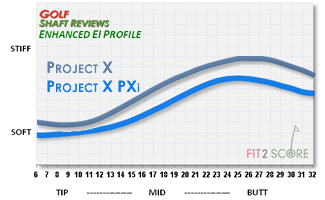
Iron shafts are getting lighter. Lighter means faster, it means more maneuverable. Think of the difference between a Carbon Fiber Lamborghini and a Heavy Metal Chevy. The light weight Lamborghini accelerates quicker, there is less weight to get moving. It corners quicker because it has less centrifugal force acting on it. The Project X PXi is a lighter faster Project X. The 6.0 model lost 12 grams of weight and 2 pounds of butt stiffness. Does it work? Ask Jason Dufner and Ian Poulter, they are both using it. And we have Tiger and Rory using it in their utility/driving irons.
Loss of weight typically means loss of stiffness. As you can see, the average stiffness profile of the PXi is softer than the average stiffness of the Project X. Once again, we see stiffness numbers on a shaft that do not indicate an absolute reference. Do not take that comment as a criticism of True Temper. It is the same scheme used by every shaft company. That is one of the many reasons that club fitting is so critically important to game development.
To continue reading this section of the review, you must be registered at a higher level membership. Russ
The Project X design is different from the stepped shafts designs made by True Temper. The EI profile is constant from flex to flex, The stiffness increases as the shaft weight increases. The numbers on the shaft, 5.0, 5.5, 6.0, 6.5 and 7.0 represent stiffness. They are a patented numbering system that dates back to FM Precision. Frequency of the shaft was translated via a linear formula into a stiffness numbering system. A 10 Cycle per Minute, CPM, difference equated to a stiffness number change. When you hear the term frequency matched shafts, it refers to a system, not necessarily the original Braly system, of matching iron set stiffness.
Here is a little history if you are interested, Union Hardware was the first manufacturer of steel golf shafts in the US in 1924. They were acquired in 1956 by Brunswick, which also owned MacGregor golf. Brunswick supplied blanks to FM Precision, a golf shaft company owned by Kim Braly and his dad, Dr. Joe Braly. In 1986 Brunswick acquired FM Precision. At some point, the name was changed to Royal Precision. In the early 2000’s Kim Braly designed the Project X and it quickly gained wide acceptance on tour. In 2006 True Temper acquired Royal Precision and the Project X brand.
To continue reading this section of the review, you must be registered at a higher level membership. Russ
The Project X is a classic, with too many tour wins count. Until competitive designs emerged, it was for many good players, the shaft of choice. Radial quality and shaft to shaft consistency in the shafts I have checked is excellent. The Project X can be installed in any orientation, being nearly perfectly round, orientation will have no affect on the play-ability of the Project X.