

TPT Red Driver Shaft Review

TPT Red Driver Shafts Review

By Russ Ryden, Fit2Score, A Dallas Fort Worth Club Fitter & Club Maker
The Highlands Performance Golf Center, Carrollton Texas 
Golf Digest Certified America’s 100 Best Club Fitter

TPT, Thin Ply Technology, has its roots in America’s Cup yacht racing. They developed carbon fiber sails for America’s Cup yachts. They shaped carbon fiber into sails that maintained their shape. After successive America’s Cup wins, TPT moved their innovative carbon fiber processes to other industries, automotive, aerospace, aviation, snow sports and golf. They construct their own prepreg from the best fibers. Then form it into structures.

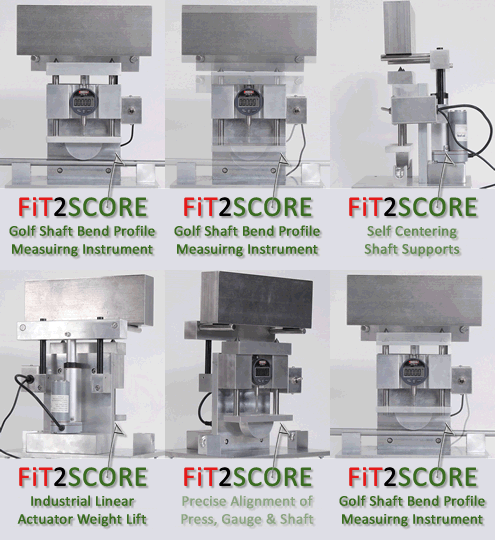
TPT makes their shafts out of carbon fiber ribbon cut from the prepreg sheets they make. The ribbon is wrapped around the shaft mandrel. The result is a seamless shaft with uniform stiffness in all orientations. That was verified in my measurement, Radial Quality, shown below. It is the best in the business.

Most shafts are hand wrapped resulting is shaft to shaft variance. TPT shafts are CNC wrapped around the shaft mandrel. This eliminates shaft to shaft variations. The shaft you are fit with is exactly the same as the shaft that will be installed in your driver.

To continue reading this section of the review, you must be registered at a higher level membership.
Russ

True Temper XP Golf Shaft Review

True Temper XP 95 Iron Shaft

By Russ Ryden, A Golf Digest America’s 100 Best Clubfitter
Fit2Score, Dallas Fort Worth, Texas

TT_XP95_image
The True Temper XP 95 is the first of a new family of iron shafts from True Temper. It is an evolution of the GS series which it will be replacing. Like the GS family, it uses a special steel alloy which has higher tensile strength allowing for lighter weight designs. That alloy has evolved from what True Temper designated as S3 in the GS75 to S5 in the XP models.

True Temper testing and player feedback is addressing the low spin balls designed to deliver driver distance. Those balls do not spin enough to get distance and drop and stop performance on longer irons. To address this, True Tempers current generation of iron shafts are aimed at increasing spin. This is also addressed in the design of the Dynamic Gold Pro progressive launch model also releasing in 2014.

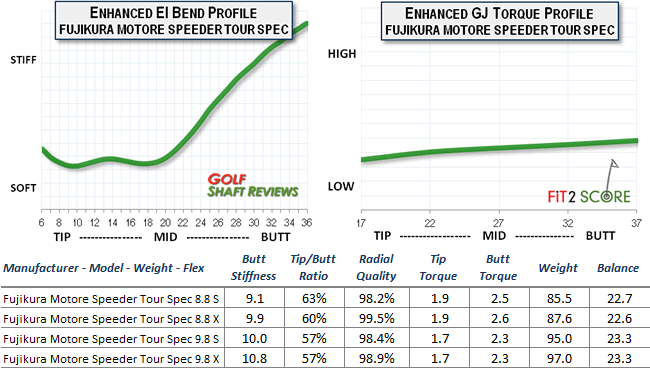
The True Temper XP uses a dual step pattern. Longer steps near the butt of the shaft, shorter steps closer to the tip. The longer steps. smaller changes in diameter per step, are called speed steps by True Temper. The shorter steps create a quicker loss of stiffness in the shaft as it gets closer to the tip. It is this property of the shaft that increases launch. That progressive stiffness loss can be seen in the EI bend profile.

To continue reading this section of the review, you must be registered at a higher level membership.
Russ

I had a chance to talk to Bill Lange, the True Temper Director of Sales, at the 2014 PGA Merchandise show about the XP shafts.

TT_XP105_image

The XP 105, available exclusively from Mizuno in 2014 is the first expansion of the XP family of shafts. I am told we will see both 85 and 115 gram versions in the near future.

To continue reading this section of the review, you must be registered at a higher level membership.
Russ
Fujikura Fuel Golf Shaft Review

FUJIKURA FUEL DRIVER SHAFT

By Kirk James & Mark Vallier, A Golf Digest America’s 100 Best Clubfitter
MK Golf Technologies,San Antonio, Texas

Fuel_Image

The Fujikura Fuel shaft was introduced just prior to the 2013 PGA Merchandise Show and was named “the most talked about shaft at the Show”. The Fuel continues to create a lot of buzz in the print media and on the internet. Let’s take a closer look and see what all the buzz is about.

According to Fujikura, the Fuel is a low launch/low spin shaft designed for drivers, fairways and hybrids. The shafts are constructed with a series of high modulus carbon plies oriented at 45 and 90 degree angles in the butt and mid sections which their engineers claim reduce ovaling during the loading and unloading of the shaft. We have found through our testing and fitting process that the Fuel shafts are extremely stable with low launch and low spin characteristics as claimed by Fujikura.

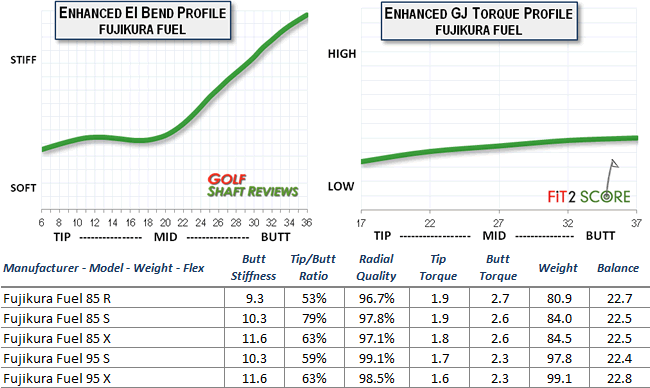
Like many shafts, the Fujikura Fuel profiles vary with weight. As you will notice in the EI bend profiles below, the 50 gram shafts have a fairly soft overall profile with a relatively stiff tip. This stiff tip feature makes this shaft feel extremely tight and stable for a mid 50 gram shaft. We have found through our fittings that it will feel and play slightly stiffer than its flex rating. It is an excellent light weight option for a player that can load a shaft or that has a quicker tempo, or both.

The 60 gram, Tour Spec 60 gram and the 70 gram models have a slightly different bend profile than the 50 gram models. These heavier models are stiffer in the butt and mid sections, with a smoother profile in the tip section. The stiffer butt and mid sections make these models feel extremely stable (ie stiff) in the hands and give these shafts an overall stiff feel. The low torque of these shafts adds to their overall tight/stiff feel at impact. Our testing and fittings confirm that these are definitely low launch shafts.

The Tour Spec 70 gram S and X flex models have a very different profile than the other models. The bend profile shows a very stiff upper-mid section with a smooth but rapid decline in flex to the tip. These models are again extremely stable because of the stiff mid section, and are excellent choices for heavy hitters looking to lower ball flight in both drivers and fairways.

Fuel EiGjTb


Fujikura Fuel Tour Spec 70 gramFuel_TS_Image


Our testing and fittings confirm that the Fujikura Fuel shafts definitely provide the low launch characteristics claimed by Fujikura. The 50 gram models have slightly higher launch and spin than the other models, but are still low for a mid-50 gram shaft. The design, construction and bend profiles of these shafts contribute to the overall stiff/tight feel that the player will experience when playing these shafts. The Fuel shafts are a good option to consider for a player looking to lower his or her launch conditions.

Oban Kiyoshi Purple, Oban Kiyoshi Black, Oban Kiyoshi White Driver Shafts

OBAN KIYOSHI DRIVER SHAFTS
OBAN KIYOSHI PURPLE
OBAN KIYOSHI BLACK
OBAN KIYOSHI WHITE

By Woody Lashen, A Golf Digest America’s 100 Best Clubfitter
Pete’s Golf, Mineola, New York

Oban introduced the Purple Kiyoshi in the fall of 2010, each year they have added a new profile to the series.  Oban’s goal was to make a high quality shaft, with different options that club fitters could use to the maximum performance out of players with different swings and needs.  As with any great shaft, we advise you go see a professional fitter to find the correct one for you to achieve the maximum  performance  for your individual game.

Oban on Tour

DevotedGolfer.tv editor Russ Ryden got to talk to Rich Parzych, Tour Representative for Oban at the Crowne Plaza Invitational at Colonial in 2013. Rich has spent many years on the PGA Tour as an owner operator of his own van and most recently at the Oban Golf Shaft tour representative.

Oban Kiyoshi Purple

Purple Image

Kiyoshi Purple was introduced first in the product line as Oban’s premium performance golf shaft. It is the highest launching shaft in the Kiyoshi line, offered in a weight range of 45-85g, The lighter weights are designed for senior and ladies flex available in the lighter weights. The Kiyoshi Purple is an extremely high quality mid launch/mid spin shaft. The 55g-85g all run the same EI profile, with similar torque. The torque ranges on all three Kiyoshi models (Purple, Black and White) are relatively low, The EI of the Kiyoshi Purple is tip stiff, extremely soft in the mid-section, and stiff in the butt. It’s a great shaft for average to mid-load profiles. With its stunning graphics, it’s difficult not to notice when a player has one in the bag.

The technical discussion and measurements are available only to registered readers

To continue reading this section of the review, you must be registered at a higher level membership.
Russ

Shaft Alignment

GOLF SHAFT ALIGNMENT

By Tom Wishon, Tom Wishon Golf Technology

This was copied from a discussion on another forum. It is the same as a private conversation I have had with Tom while researching the history of SST alignment.

“I was the guy that Dick Weiss came to back in 1996 after he had been doing his initial research into the effects of shaft asymmetry, when he wanted someone to verify what he was seeing in his initial work. Dick insisted that the result of testing we did for him was to be kept confidential. We honored that request.

But I can tell you that back then, while shaft makers were aware that their shafts did not have the same exact bending properties in all directions about the circumference of their shafts, they did not have any awareness of how asymmetrical many of their shafts were, and what this could do to shot performance for certain swing types.

So yes, shafts back then exhibited a very wide range of asymmetry. And in our testing for Dick, we most certainly saw that finding the most stable plane of bending in these asymmetrical shafts and then orienting that plane at the target line most certainly improved the consistency of the impact and ball flight. We even were able to orient certain shafts in a way in which it virtually made it impossible to hit a draw or fade.

This was a point that the USGA also discovered when Dick came to them to appeal for a conformity ruling for his process. The USGA did actually write into their rule concerining shaft orientation that it was only to be done to allow shafts to play as they were intended to be designed to play, and not to be done for the purpose of purposely influencing the flight of the ball.

Once Dick’s SST PURE process became more and more known, the shaft makers began to look more closely into this. Today, most of the better shaft makers do institute a test or tests on all of their shafts as a normal step in production. From this they position the shafts’ logo/name such that what they find under their test as a stable plane of bending is then oriented at the target when the shaft is installed logo up or logo down.

So today you won’t see as wide of a variation in asymmetry in shafts made by quality shaft makers as there was back when Dick discovered this and invented his process. But because every shaft maker has a “flyer shaft” here and there, there are times purely at random when a golfer might have a shaft checked and re oriented and see a difference in impact consistency on the face and a change in ball flight.”

TOM