VA Composites Vylyn Golf Shaft Review

VA Composites Vylyn Golf Shaft Review

By Russ Ryden, Fit2Score, A Dallas Fort Worth Club Fitter & Club Maker

The Highlands Performance Golf Center, Carrollton Texas 
Golf Digest Certified America’s 100 Best Club Fitter

VA Composites was created in 2017 by Victor Afable. Victor has been in the golf business over 35 years. Much of it with golf shaft companies. He is now the owner of VA Composites and responsible for the design of VA Composite shafts. His past designs have over 100 tour wins including a major.

The VA Composite Vylyn (Villain) is a mid price shaft designated as Mid-High Launch. It is offered in weights ranging from 48g to 66g. The Tip/Butt stiffness is higher than what we saw in the Slay, validating the launch propensity stated by VA Composites. Lets take a look at the data. 

To continue reading this section of the review, you must be registered at a higher level membership.
Russ

KuroKage Silver TiNi Driver Shaft Review

Mitsubishi KURO KAGE Silver with TiNi

By Russ Ryden, Fit2Score, A Dallas Fort Worth Club Fitter & Club Maker

The Golf Center at the Highlands, Carrollton Texas

KuroKageSilverTiNiImageThe Mitsubishi Kuro Kage Silver has been updated in 2013 with the addition of 8 inches of Titanium Nickel Wire wrapped into the tip section of the shaft. The graphics are slightly different and the tip bears the TiNi logo used on Mitsubishi shafts with Titanium Nickel wire tip reinforcement. The KuroKage line was the first of the Mitsubishi products to use high density pregreg, The Kuro Kage shafts have this high density material added to the lower third of the shaft.

KuroKageSilverTiNivsFubukiKThe EI Bend Profile Signature is similar to the Fubuki K. The Fubuki K and its predecessor, the Fubuki Tour continue to stiffen from 11″ to the tip, while the Kuro Kage Silver softens. Both have a slight mid zone stiffness bump, like the Diamana White Board with that bump occurring closer to the tip in the Kuro Kage Silver to promote a little higher launch.

KuroKageSilverTiNiEiGjTb
While this is a mid priced shaft, $300 MSRP, in the Mitsubishi family of golf shafts you would not know that by looking at the radial quality. I cannot ever remember having 6 shafts in my hand that at most, varied by 1 CPM from hard to soft plane. Awesome. In a marketplace where every driver shaft has a rotating hosel, we should expect no less. And this shaft proves the manufacturing technology exists. What we do see in the Kuro Kage Silver TiNi is slightly higher torque in the R & S flex models than the Diamana and Fubuki series. Evidence of player profiling design, the players using the R & S will load the shaft less and get more feel from higher torque. Those using the X flex models need the control of low torque.

KURO KAGE SILVER Range Test

The difference between the previous version of the KUROKAGE Silver and the 2014 model is the addition of 8 inches of Titanium Nickel wire in the tip section. That gave us an opportunity to test the fiber by comparing the two shafts with a PGA tour quality ball striker, Mark Maness.KuroKageTestAverages
As you can see from this composite FlightScope report, the TiNi material did indeed add distance, reducing launch and spin with a slight increase in club head speed. Mark commented during the tests that the tip of the Kuro Kage with the TiNi felt more stable. That in a shaft with a softer tip than he has in his gamer. Its always nice to see that a technical improvement in a golf product actually results in improved performance and is not just more marketing hype.

Grafalloy BiMatrix Tour Prototype Golf Shaft Review

Grafalloy BiMatrix Tour Prototype

By Russ Ryden, A Golf Digest America’s 100 Best Clubfitter
Fit2Score, Dallas Fort Worth, Texas

BiMatrix_Image

Bubba Watson plays the Grafalloy BiMatrix driver shaft and won the 2012 Masters with it. When he came on tour he showed up with one painted pink. Grafalloy accommodated him and made them in pink. For those that are not ready to play with a pink driver shaft it is also available in baby blue.

This design was introduced about 10 years ago and I tried it at the time. It was black back then and I still have an original R in the shop. I profiled it a few years ago and was surprised at the profile. It looked like a high launch design. The R flex profile from the original looks like the X flex I just profiled for this review. The current R & S flex have been redesigned for the typical R or S player.

To continue reading this section of the review, you must be registered at a higher level membership.
Russ

Project X PXi Golf Shaft Review

Project X PXi Iron Shaft from True Temper

By Russ Ryden, A Golf Digest America’s 100 Best Clubfitter
Fit2Score, Dallas Fort Worth, Texas

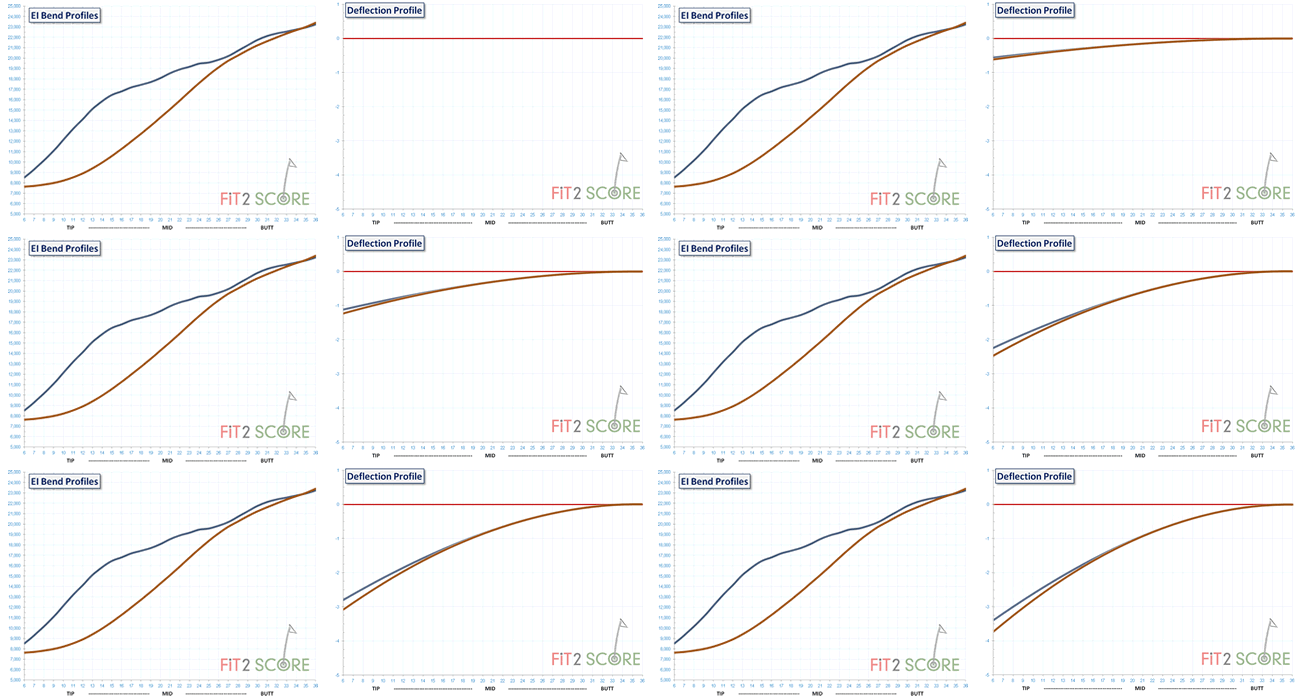
ProjectX_PXi_imageTT_PXvsPXi_EiIron shafts are getting lighter. Lighter means faster, it means more maneuverable. Think of the difference between a Carbon Fiber Lamborghini and a Heavy Metal Chevy. The light weight Lamborghini accelerates quicker, there is less weight to get moving. It corners quicker because it has less centrifugal force acting on it. The Project X PXi is a lighter faster Project X. The 6.0 model lost 12 grams of weight and 2 pounds of butt stiffness. Does it work? Ask Jason Dufner and Ian Poulter, they are both using it. And we have Tiger and Rory using it in their utility/driving irons.

Loss of weight typically means loss of stiffness. As you can see, the average stiffness profile of the PXi is softer than the average stiffness of the Project X. Once again, we see stiffness numbers on a shaft that do not indicate an absolute reference. Do not take that comment as a criticism of True Temper. It is the same scheme used by every shaft company. That is one of the many reasons that club fitting is so critically important to game development.

To continue reading this section of the review, you must be registered at a higher level membership.
Russ

Project X Golf Shaft Review

Project X Iron Shaft from True Temper

By Russ Ryden, A Golf Digest America’s 100 Best Clubfitter
Fit2Score, Dallas Fort Worth, Texas

ProjectXImage

The Project X design is different from the stepped shafts designs made by True Temper. The EI profile is constant from flex to flex, The stiffness increases as the shaft weight increases. The numbers on the shaft, 5.0, 5.5, 6.0, 6.5 and 7.0 represent stiffness. They are a patented numbering system that dates back to FM Precision. Frequency of the shaft was translated via a linear formula into a stiffness numbering system. A 10 Cycle per Minute, CPM, difference equated to a stiffness number change. When you hear the term frequency matched shafts, it refers to a system, not necessarily the original Braly system, of matching iron set stiffness.

Here is a little history if you are interested, Union Hardware was the first manufacturer of steel golf shafts in the US in 1924. They were acquired in 1956 by Brunswick, which also owned MacGregor golf. Brunswick supplied blanks to FM Precision, a golf shaft company owned by Kim Braly and his dad, Dr. Joe Braly.  In 1986 Brunswick acquired FM Precision. At some point, the name was changed to Royal Precision. In the early 2000’s Kim Braly designed the Project X and it quickly gained wide acceptance on tour. In 2006 True Temper acquired Royal Precision and the Project X brand.

To continue reading this section of the review, you must be registered at a higher level membership.
Russ

The Project X is a classic, with too many tour wins count. Until competitive designs emerged, it was for many good players, the shaft of choice. Radial quality and shaft to shaft consistency in the shafts I have checked is excellent. The Project X can be installed in any orientation, being nearly perfectly round, orientation will have no affect on the play-ability of the Project X.

True Temper Project X PXV 39 Golf Shaft Review

True Temper Project X PXV 39 Driver Shaft

By Russ Ryden, A Golf Digest America’s 100 Best Clubfitter
Fit2Score, Dallas Fort Worth, Texas

TTPX PXv39 ImageI have seen fair number of driver shafts with labels implying light weights, but I have only seen one shaft that was labeled with a number that actually was the weight of the raw 46″ shaft. The True Temper Project X PXv 39 is correctly labeled. The raw shaft is 39 grams. It is like holding a feather in your hands. When I start measuring a shaft I usually start with the EI profiles. With the Project X PXv 39 I started with radial quality. Surely a shaft this light was likely to have a low number. The number was shocking, the review samples were close to perfect. If you are going to make a shaft with walls as thin as they are on the PXv 39, they need to be perfect. This is a 39 gram shaft that can be oriented in any direction in a rotating hosel. It is the light weight version of the Project X PXv family of shafts.

While the torque numbers at first glance look high, they are as low as I see in shafts of this weight. I would not be putting this shaft in the hands of an aggressive high speed ball striker. However, at 6.4 to 7.0 pounds of butt stiffness, these are not wimpy shafts.

TTPX EIGjTb PXv39The bend profile is not uncommon for shafts in this weight range. I have had a lot of success fitting a similar profile in this weight range. The quick decline in stiffness in the high mid area, combined with a long stable tip section results in the launch needed in this weight range with good dispersion control. I am seeing this design in a number of high performance golf shafts.

TTPX PXv39 TipI have heard shaft designers discuss the weight of paint on ultralight driver shafts. There is no elegant glossy overcoat on the Project X PXv 39, every possible aspect of weight control went into this design. It is available only through True Temper Performance Fitting Centers. One look at the wall thickness of the tip and you will quickly realize this shaft should be installed by a competent club builder. High modulus carbon fiber are making designs possible that could not be considered a few years ago. The Project X PXv 39 is one such design.